


Page 590 - Ultimate Visual Dictionary (DK)
P. 590
THE MODERN WORLD
       Cellphones                                            Top           Front

                                                             microphone    camera
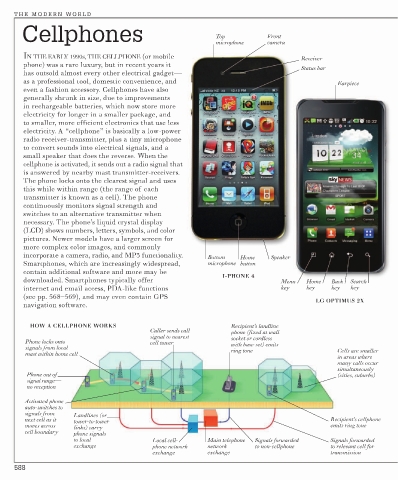
        IN THE EARLY 1990s, THE CELLPHONE (or mobile                                 Receiver
        phone) was a rare luxury, but in recent years it
                                                                                     Status bar
        has outsold almost every other electrical gadget—
        as a professional tool, domestic convenience, and                                      Earpiece
        even a fashion accessory. Cellphones have also
        generally shrunk in size, due to improvements
        in rechargeable batteries, which now store more
        electricity for longer in a smaller package, and
        to smaller, more efficient electronics that use less
        electricity. A “cellphone” is basically a low-power
        radio receiver-transmitter, plus a tiny microphone
        to convert sounds into electrical signals, and a
        small speaker that does the reverse. When the
        cellphone is activated, it sends out a radio signal that
        is answered by nearby mast transmitter -receivers.
        The phone locks onto the clearest signal and uses
        this while within range (the range of each
        transmitter is known as a cell). The phone
        continuously monitors signal strength and
        switches to an alternative transmitter when
        necessary. The phone’s liquid crystal display
        (LCD) shows numbers, letters, symbols, and color
        pictures. Newer models have a larger screen for
        more complex color images, and commonly
        incorporate a camera, radio, and MP3 functionality.   Bottom   Home   Speaker
        Smartphones, which are increasingly widespread,    microphone  button
        contain additional software and more may be
                                                               I-PHONE 4
        downloaded. Smartphones typically offer                                Menu   Home   Back   Search
        internet and email access, PDA-like functions                          key    key    key  key
        (see pp. 568–569), and may even contain GPS
                                                                                         LG OPTIMUS 2X
        navigation software.

         HOW A CELLPHONE WORKS                                   Recipient’s landline
                                           Caller sends call     phone (fixed at wall
                                           signal to nearest     socket or cordless
        Phone locks onto                   cell tower            with base-set) emits
        signals from local                                       ring tone                     Cells are smaller
        mast within home cell
                                                                                               in areas where
                                                                                               many calls occur
                                                                                               simultaneously
        Phone out of                                                                           (cities, suburbs)
        signal range—
        no reception
        Activated phone
        auto-switches to
        signals from   Landlines (or
        next cell as it   tower-to-tower                                                     Recipient’s cellphone
        moves across   links) carry                                                          emits ring tone
        cell boundary  phone signals
                     to local              Local cell-     Main telephone   Signals forwarded   Signals forwarded
                     exchange              phone network   network      to non-cellphone     to relevant cell for
                                           exchange        exchange                          transmission

     588

