


Page 84 - Ultimate Visual Dictionary (DK)
P. 84
PREHISTORIC EAR TH
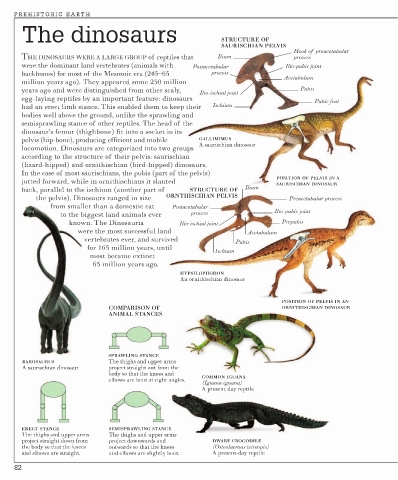
       The dinosaurs                                           STRUCTURE OF


                                                               SAURISCHIAN PELVIS
                                                                                   Hook of  preacetabular
       THE DINOSAURS WERE A LARGE GROUP of reptiles that     Ilium                 process
       were the dominant land vertebrates (animals with   Postacetabular        Ilio-pubic joint
       backbones) for most of the Mesozoic era (245–65      process
                                                                                Acetabulum
       million years ago). They appeared some 230 million
       years ago and were distinguished from other scaly,                           Pubis
                                                        Ilio-ischial joint
       egg-laying reptiles by an important feature: dinosaurs                           Pubic foot
       had an erect limb stance. This enabled them to keep their   Ischium
       bodies well above the ground, unlike the sprawling and
       semisprawling stance of other reptiles. The head of the
       dinosaur’s femur (thighbone) fit into a socket in its
       pelvis (hip-bone), producing efficient and mobile   GALLIMIMUS
                                                        A saurischian dinosaur
       locomotion. Dinosaurs are categorized into two groups
       according to the structure of their pelvis: saurischian
       (lizard-hipped) and ornithischian (bird-hipped) dinosaurs.
       In the case of most saurischians, the pubis (part of the pelvis)
                                                                              POSITION OF PELVIS IN A
       jutted forward, while in ornithischians it slanted                     SAURISCHIAN DINOSAUR
       back, parallel to the ischium (another part of   STRUCTURE OF   Ilium
           the pelvis). Dinosaurs ranged in size   ORNTHISCHIAN PELVIS           Preacetabular process
               from smaller than a domestic cat   Postacetabular
                  to the biggest land animals ever    process                Ilio-pubic joint
                    known. The Dinosauria          Ilio-ischial joint          Prepubis
                       were the most successful land                  Acetabulum
                        vertebrates ever, and survived
                                                                  Pubis
                         for 165 million years, until
                                                             Ischium
                          most became extinct
                           65 million years ago.
                                                   HYPSILOPHODON
                                                   An ornithischian dinosaur


                                                                               POSITION OF PELVIS IN AN
                               COMPARISON OF                                   ORNITHISCHIAN DINOSAUR
                               ANIMAL STANCES


                               SPRAWLING STANCE
       BAROSAURUS              The thighs and upper arms
       A saurischian dinosaur  project straight out from the
                               body so that the knees and
                               elbows are bent at right angles.  COMMON IGUANA
                                                         (Iguana iguana)
                                                         A present-day reptile


       ERECT STANCE            SEMISPRAWLING STANCE
       The thighs and upper arms   The thighs and upper arms
       project straight down from   project downwards and   DWARF CROCODILE
       the body so that the knees   outwards so that the knees   (Osteolaemus tetraspis)
       and elbows are straight.  and elbows are slightly bent.  A present-day reptile

     82

