


Page 82 - Ultimate Visual Dictionary (DK)
P. 82
PREHISTORIC EAR TH

       Amphibians and reptiles


                                                                                                Pocket
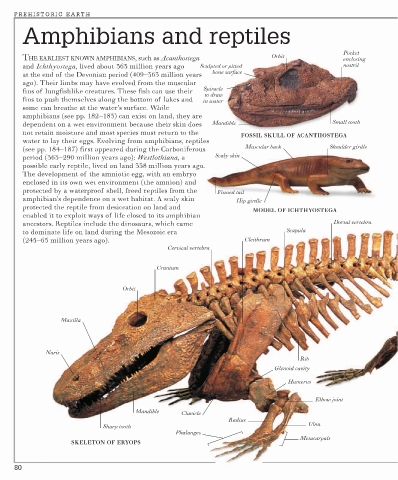
       THE EARLIEST KNOWN AMPHIBIANS, such as Acanthostega                  Orbit               enclosing
       and Ichthyostega, lived about 363 million years ago   Sculpted or pitted                 nostril
                                                            bone surface
       at the end of the Devonian period (409–363 million years
       ago). Their limbs may have evolved from the muscular
                                                          Spiracle
       fins of lungfishlike creatures. These fish can use their
                                                          to draw
       fins to push themselves along the bottom of lakes and   in water
       some can breathe at the water’s surface. While
       amphibians (see pp. 182–183) can exist on land, they are
       dependent on a wet environment because their skin does   Mandible                     Small tooth
       not retain moisture and most species must return to the
                                                                    FOSSIL SKULL OF ACANTHOSTEGA
       water to lay their eggs. Evolving from amphibians, reptiles
       (see pp. 184–187) first appeared during the Carboniferous     Muscular back           Shoulder girdle
       period (363–290 million years ago): Westlothiana, a   Scaly skin
       possible early reptile, lived on land 338 million years ago.
       The development of the amniotic egg, with an embryo
       enclosed in its own wet environment (the amnion) and
       protected by a waterproof shell, freed reptiles from the   Finned tail
       amphibian’s dependence on a wet habitat. A scaly skin       Hip girdle
       protected the reptile from desiccation on land and
                                                                       MODEL OF ICHTHYOSTEGA
       enabled it to exploit ways of life closed to its amphibian
       ancestors. Reptiles include the dinosaurs, which came                                  Dorsal vertebra
       to dominate life on land during the Mesozoic era                          Scapula
       (245–65 million years ago).                                   Cleithrum
                                                Cervical vertebra

                                             Cranium


                                   Orbit


                  Maxilla


              Naris
                                                                                    Rib
                                                                             Glenoid cavity
                                                                                 Humerus

                                                                                         Elbow joint
                                       Mandible    Clavicle
                                                                Radius
                              Sharp tooth                                              Ulna
                                                  Phalanges
                                                                                    Metacarpals
                     SKELETON OF ERYOPS


     80

