


Page 143 - Easy Japanese - Learn to Speak Japanese Quickly! (TUTTLE)
P. 143
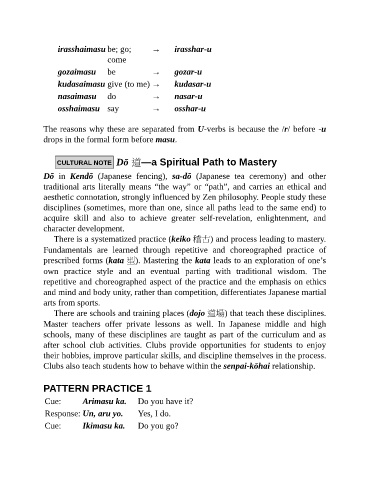
irasshaimasu be; go;           →       irasshar-u
                                     come
                    gozaimasu        be            →       gozar-u

                    kudasaimasu give (to me) →             kudasar-u
                    nasaimasu        do            →       nasar-u

                    osshaimasu say                 →       osshar-u


               The reasons why these are separated from U-verbs is because the /r/ before -u
               drops in the formal form before masu.


                    CULTURAL NOTE  Dō 道—a Spiritual Path to Mastery

               Dō  in  Kendō  (Japanese  fencing),  sa-dō  (Japanese  tea  ceremony)  and  other
               traditional arts literally means “the way” or “path”, and carries an ethical and
               aesthetic connotation, strongly influenced by Zen philosophy. People study these
               disciplines (sometimes, more than one, since all paths lead to the same end) to
               acquire  skill  and  also  to  achieve  greater  self-revelation,  enlightenment,  and
               character development.

                   There is a systematized practice (keiko 稽古) and process leading to mastery.
               Fundamentals  are  learned  through  repetitive  and  choreographed  practice  of
               prescribed forms (kata 型). Mastering the kata leads to an exploration of one’s
               own  practice  style  and  an  eventual  parting  with  traditional  wisdom.  The
               repetitive and choreographed aspect of the practice and the emphasis on ethics

               and mind and body unity, rather than competition, differentiates Japanese martial
               arts from sports.
                   There are schools and training places (dojo 道場) that teach these disciplines.
               Master  teachers  offer  private  lessons  as  well.  In  Japanese  middle  and  high
               schools, many of these disciplines are taught as part of the curriculum and as
               after  school  club  activities.  Clubs  provide  opportunities  for  students  to  enjoy

               their hobbies, improve particular skills, and discipline themselves in the process.
               Clubs also teach students how to behave within the senpai-kōhai relationship.


               PATTERN PRACTICE 1

                Cue:        Arimasu ka.        Do you have it?

                Response: Un, aru yo.          Yes, I do.
                Cue:        Ikimasu ka.        Do you go?

