


Page 142 - Easy Japanese - Learn to Speak Japanese Quickly! (TUTTLE)
P. 142
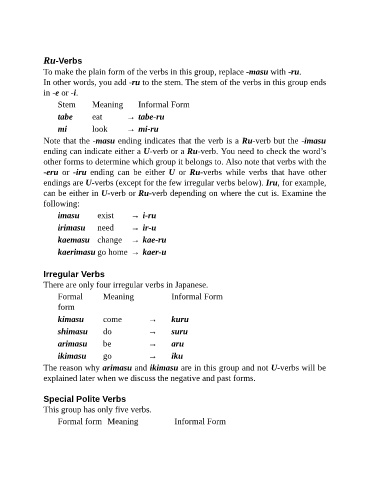
Ru-Verbs
               To make the plain form of the verbs in this group, replace -masu with -ru.
               In other words, you add -ru to the stem. The stem of the verbs in this group ends
               in -e or -i.

                    Stem        Meaning        Informal Form

                    tabe        eat        → tabe-ru
                    mi          look       → mi-ru
               Note that the -masu ending indicates that the verb is a Ru-verb but the -imasu
               ending can indicate either a U-verb or a Ru-verb. You need to check the word’s

               other forms to determine which group it belongs to. Also note that verbs with the
               -eru  or  -iru  ending  can  be  either  U  or  Ru-verbs  while  verbs  that  have  other
               endings are U-verbs (except for the few irregular verbs below). Iru, for example,
               can be either in U-verb or Ru-verb depending on where the cut is. Examine the
               following:

                    imasu        exist      → i-ru
                    irimasu      need       → ir-u

                    kaemasu change          → kae-ru
                    kaerimasu go home → kaer-u


               Irregular Verbs
               There are only four irregular verbs in Japanese.
                    Formal         Meaning                Informal Form

                    form
                    kimasu         come           →       kuru

                    shimasu        do             →       suru
                    arimasu        be             →       aru

                    ikimasu        go             →       iku
               The reason why arimasu and ikimasu are in this group and not U-verbs will be
               explained later when we discuss the negative and past forms.


               Special Polite Verbs
               This group has only five verbs.
                    Formal form Meaning                    Informal Form

