


Page 222 - Easy Japanese - Learn to Speak Japanese Quickly! (TUTTLE)
P. 222
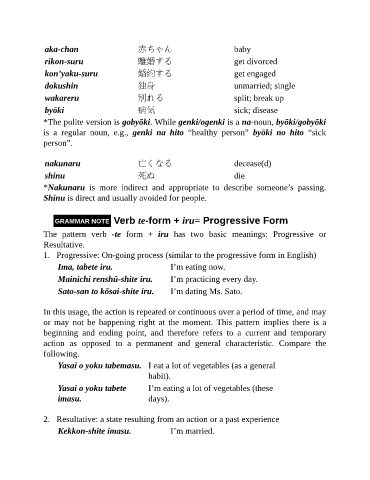
aka-chan                       赤ちゃん                           baby
                rikon-suru                     離婚する                           get divorced
                kon’yaku-suru                  婚約する                           get engaged

                dokushin                       独身                             unmarried; single

                wakareru                       別れる                            split; break up
                byōki                          病気                             sick; disease
               *The polite version is gobyōki. While genki/ogenki is a na-noun, byōki/gobyōki

               is  a  regular  noun,  e.g.,  genki  na  hito  “healthy  person”  byōki  no  hito  “sick
               person”.


                nakunaru                       亡くなる                           decease(d)

                shinu                          死ぬ                             die
               *Nakunaru  is  more  indirect  and  appropriate  to  describe  someone’s  passing.
               Shinu is direct and usually avoided for people.


                   GRAMMAR NOTE Verb te-form + iru= Progressive Form

               The  pattern  verb  -te  form  +  iru  has  two  basic  meanings:  Progressive  or
               Resultative.
               1. Progressive: On-going process (similar to the progressive form in English)
                    Ima, tabete iru.                     I’m eating now.

                    Mainichi renshū-shite iru.           I’m practicing every day.

                    Sato-san to kōsai-shite iru.         I’m dating Ms. Sato.


               In this usage, the action is repeated or continuous over a period of time, and may
               or  may  not  be  happening  right at the moment. This pattern implies there is a
               beginning  and  ending  point,  and  therefore  refers  to  a  current  and  temporary
               action  as  opposed  to  a  permanent  and  general  characteristic.  Compare  the
               following.

                    Yasai o yoku tabemasu. I eat a lot of vegetables (as a general
                                                  habit).
                    Yasai o yoku tabete           I’m eating a lot of vegetables (these

                    imasu.                        days).


               2. Resultative: a state resulting from an action or a past experience
                    Kekkon-shite imasu.                  I’m married.

