


Page 51 - Easy Japanese - Learn to Speak Japanese Quickly! (TUTTLE)
P. 51
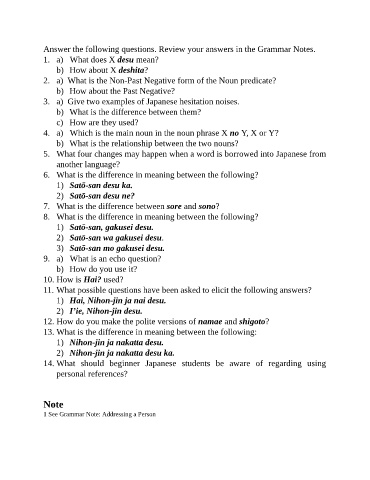
Answer the following questions. Review your answers in the Grammar Notes.
               1. a)  What does X desu mean?
                    b) How about X deshita?
               2. a) What is the Non-Past Negative form of the Noun predicate?
                    b) How about the Past Negative?
               3. a) Give two examples of Japanese hesitation noises.
                    b) What is the difference between them?

                    c) How are they used?
               4. a)  Which is the main noun in the noun phrase X no Y, X or Y?
                    b) What is the relationship between the two nouns?
               5. What four changes may happen when a word is borrowed into Japanese from
                    another language?
               6. What is the difference in meaning between the following?

                    1) Satō-san desu ka.
                    2) Satō-san desu ne?
               7. What is the difference between sore and sono?
               8. What is the difference in meaning between the following?
                    1) Satō-san, gakusei desu.
                    2) Satō-san wa gakusei desu.
                    3) Satō-san mo gakusei desu.

               9. a)  What is an echo question?
                    b) How do you use it?
               10. How is Hai? used?
               11. What possible questions have been asked to elicit the following answers?
                    1) Hai, Nihon-jin ja nai desu.

                    2) I’ie, Nihon-jin desu.
               12. How do you make the polite versions of namae and shigoto?
               13. What is the difference in meaning between the following:
                    1) Nihon-jin ja nakatta desu.
                    2) Nihon-jin ja nakatta desu ka.
               14. What  should  beginner  Japanese  students  be  aware  of  regarding  using
                    personal references?


               Note
               1 See Grammar Note: Addressing a Person

