


Page 85 - Easy Japanese - Learn to Speak Japanese Quickly! (TUTTLE)
P. 85
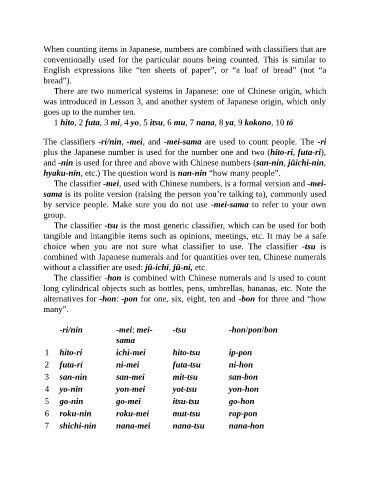
When counting items in Japanese, numbers are combined with classifiers that are
               conventionally  used  for  the  particular  nouns  being  counted.  This  is  similar  to
               English  expressions  like  “ten  sheets  of  paper”,  or  “a  loaf  of  bread”  (not  “a
               bread”).
                   There are two numerical systems in Japanese: one of Chinese origin, which
               was introduced in Lesson 3, and another system of Japanese origin, which only
               goes up to the number ten.

                   1 hito, 2 futa, 3 mi, 4 yo, 5 itsu, 6 mu, 7 nana, 8 ya, 9 kokono, 10 tō


               The classifiers -ri/nin, -mei, and -mei-sama  are used to count people.  The -ri
               plus the Japanese number is used for the number one and two (hito-ri, futa-ri),
               and -nin is used for three and above with Chinese numbers (san-nin, jūichi-nin,
               hyaku-nin, etc.) The question word is nan-nin “how many people”.
                   The classifier -mei, used with Chinese numbers, is a formal version and -mei-
               sama is its polite version (raising the person you’re talking to), commonly used

               by service people. Make sure you do not use -mei-sama to refer to your own
               group.
                   The classifier -tsu is the most generic classifier, which can be used for both
               tangible and intangible items such as opinions, meetings, etc. It may be a safe
               choice  when  you  are  not  sure  what  classifier  to  use.  The  classifier  -tsu  is
               combined with Japanese numerals and for quantities over ten, Chinese numerals
               without a classifier are used: jū-ichi, jū-ni, etc.

                   The classifier -hon is combined with Chinese numerals and is used to count
               long cylindrical objects such as bottles, pens, umbrellas, bananas, etc. Note the
               alternatives for -hon: -pon for one, six, eight, ten and -bon for three and “how
               many”.


                     -ri/nin           -mei; mei-         -tsu               -hon/pon/bon

                                       sama
                1    hito-ri           ichi-mei           hito-tsu           ip-pon
                2    futa-ri           ni-mei             futa-tsu           ni-hon

                3    san-nin           san-mei            mit-tsu            san-bon

                4    yo-nin            yon-mei            yot-tsu            yon-hon
                5    go-nin            go-mei             itsu-tsu           go-hon

                6    roku-nin          roku-mei           mut-tsu            rop-pon
                7    shichi-nin        nana-mei           nana-tsu           nana-hon

