


Page 292 - (DK) The Ultimate Visual Dictionary 2nd Ed.
P. 292
GEOLOGY, GEOGRAPHY, AND METEOROLOGY

       River features                                                               HOW WATERFALLS AND
                                                                                    RAPIDS ARE FORMED
                                                                                                Plunge
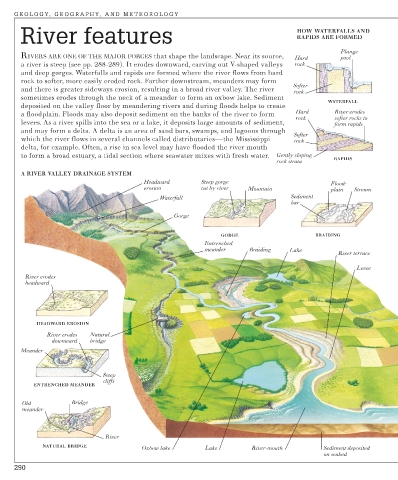
       RIVERS ARE ONE OF THE MAJOR FORCES that shape the landscape. Near its source,   Hard     pool
       a river is steep (see pp. 288-289). It erodes downward, carving out V-shaped valleys   rock
       and deep gorges. Waterfalls and rapids are formed where the river flows from hard
       rock to softer, more easily eroded rock. Farther downstream, meanders may form
                                                                                   Softer
       and there is greater sideways erosion, resulting in a broad river valley. The river   rock
       sometimes erodes through the neck of a meander to form an oxbow lake. Sediment
                                                                                            WATERFALL
       deposited on the valley floor by meandering rivers and during floods helps to create
       a floodplain. Floods may also deposit sediment on the banks of the river to form   Hard   River erodes
                                                                                   rock       softer rocks to
       levees. As a river spills into the sea or a lake, it deposits large amounts of sediment,   form rapids
       and may form a delta. A delta is an area of sand bars, swamps, and lagoons through
                                                                                   Softer
       which the river flows in several channels called distributaries—the Mississippi   rock
       delta, for example. Often, a rise in sea level may have flooded the river mouth
       to form a broad estuary, a tidal section where seawater mixes with fresh water.  Gently sloping
                                                                              rock strata     RAPIDS
       A RIVER VALLEY DRAINAGE SYSTEM
                                         Headward        Steep gorge                         Flood-
                                         erosion         cut by river  Mountain              plain  Stream
                                             Waterfall                            Sediment
                                                                                  bar
                                                 Gorge

                                                              GORGE                      BRAIDING
                                                          Entrenched
                                                          meander     Braiding   Lake
                                                                                               River terrace
                                                                                                    Levee
        River erodes
        headward


           HEADWARD EROSION
              River erodes   Natural
               downward   bridge
       Meander


                              Steep
                              cliffs
          ENTRENCHED MEANDER

       Old           Bridge
       meander


                              River
             NATURAL BRIDGE
                                        Oxbow lake        Lake         River-mouth         Sediment deposited
                                                                                           on seabed
     290

