


Page 296 - (DK) The Ultimate Visual Dictionary 2nd Ed.
P. 296
GEOLOGY, GEOGRAPHY, AND METEOROLOGY

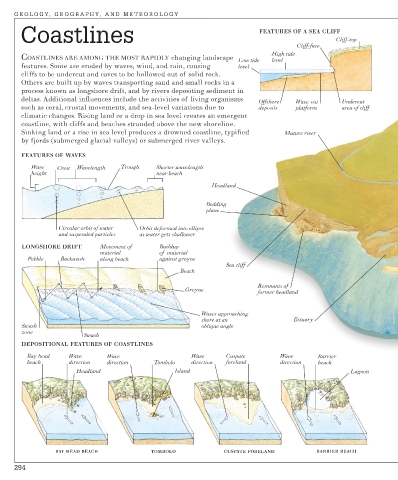
       Coastlines                                                        FEATURES OF A SEA CLIFF
                                                                                              Cliff-top
                                                                                   Cliff-face
                                                                            High tide
       COASTLINES ARE AMONG THE MOST RAPIDLY changing landscape
                                                                   Low tide   level
       features. Some are eroded by waves, wind, and rain, causing   level
       cliffs to be undercut and caves to be hollowed out of solid rock.
       Others are built up by waves transporting sand and small rocks in a
       process known as longshore drift, and by rivers depositing sediment in
       deltas. Additional influences include the activities of living organisms
                                                                         Offshore   Wave-cut    Undercut
       such as coral, crustal movements, and sea-level variations due to   deposits  platform   area of cliff
       climatic changes. Rising land or a drop in sea level creates an emergent
       coastline, with cliffs and beaches stranded above the new shoreline.
       Sinking land or a rise in sea level produces a drowned coastline, typified   Mature river
       by fjords (submerged glacial valleys) or submerged river valleys.

       FEATURES OF WAVES
          Wave   Crest  Wavelength  Trough  Shorter wavelength
          height                            near beach
                                                            Headland

                                                          Bedding
                                                          plane

                 Circular orbit of water   Orbit deformed into ellipse
                 and suspended particles  as water gets shallower
       LONGSHORE DRIFT       Movement of     Buildup
                             material        of  material
         Pebble   Backwash   along beach     against groyne
                                                                Sea cliff
                                                   Beach
                                                                         Remnants of
                                                    Groyne
                                                                         former headland

                                                         Waves approaching
                                                         shore at an               Estuary
       Swash                                             oblique angle
       zone
                        Swash
       DEPOSITIONAL FEATURES OF COASTLINES
         Bay head   Wave       Wave                   Wave      Cuspate        Wave      Barrier
         beach      direction  direction    Tombolo   direction  foreland      direction  beach
                      Headland                    Island                                          Lagoon


                BAY HEAD BEACH             TOMBOLO             CUSPATE FORELAND          BARRIER BEACH

     294

