


Page 320 - (DK) The Ultimate Visual Dictionary 2nd Ed.
P. 320
PHYSICS AND CHEMISTR Y

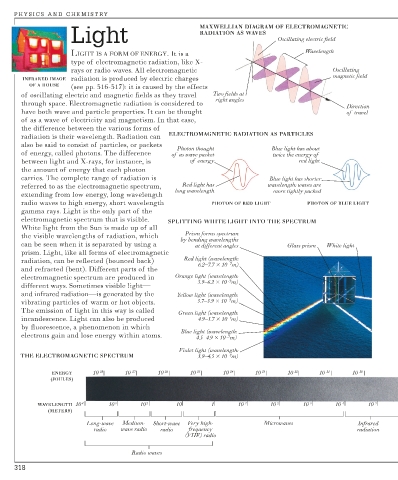
                     Light                               MAXWELLIAN DIAGRAM OF ELECTROMAGNETIC
                                                         RADIATION AS WAVES
                                                                              Oscillating electric field
                                                                                      Wavelength
                     LIGHT IS A FORM OF ENERGY. It is a
                     type of electromagnetic radiation, like X-
                     rays or radio waves. All electromagnetic                                Oscillating
       INFRARED IMAGE   radiation is produced by electric charges                            magnetic field
         OF A HOUSE  (see pp. 316-317): it is caused by the effects
       of oscillating electric and magnetic fields as they travel   Two fields at
                                                             right angles
       through space. Electromagnetic radiation is considered to
                                                                                                 Direction
       have both wave and particle properties. It can be thought                                 of  travel
       of as a wave of electricity and magnetism. In that case,
       the difference between the various forms of
                                                ELECTROMAGNETIC RADIATION AS PARTICLES
       radiation is their wavelength. Radiation can
       also be said to consist of particles, or packets
                                                  Photon thought            Blue light has about
       of energy, called photons. The difference   of  as wave packet        twice the energy of
       between light and X-rays, for instance, is     of  energy                    red light
       the amount of energy that each photon
       carries. The complete range of radiation is                          Blue light has shorter
       referred to as the electromagnetic spectrum,   Red light has        wavelength: waves are
                                                  long wavelength            more tightly packed
       extending from low energy, long wavelength
       radio waves to high energy, short wavelength         PHOTON OF RED LIGHT       PHOTON OF BLUE LIGHT
       gamma rays. Light is the only part of the
       electromagnetic spectrum that is visible.   SPLITTING WHITE LIGHT INTO THE SPECTRUM
       White light from the Sun is made up of all
                                                    Prism forms spectrum
       the visible wavelengths of radiation, which
                                                   by bending wavelengths
       can be seen when it is separated by using a     at different angles       Glass prism  White light
       prism. Light, like all forms of electromagnetic
       radiation, can be reflected (bounced back)   Red light (wavelength:
                                                        6.2–7.7 × 10  -7 m)
       and refracted (bent). Different parts of the
       electromagnetic spectrum are produced in   Orange light (wavelength:
                                                        5.9–6.2 × 10  -7 m)
       different ways. Sometimes visible light—
       and infrared radiation—is generated by the   Yellow light (wavelength:
       vibrating particles of warm or hot objects.      5.7–5.9 × 10  -7 m)
       The emission of light in this way is called   Green light (wavelength:
       incandescence. Light can also be produced        4.9–5.7 × 10  m)
                                                                -7
       by fluorescence, a phenomenon in which
                                                   Blue light (wavelength:
       electrons gain and lose energy within atoms.     4.5–4.9 × 10  -7 m)
                                                   Violet light (wavelength:
       THE ELECTROMAGNETIC SPECTRUM                     3.9–4.5 × 10  -7 m)

               ENERGY      10  -28  10  -27  10  -26  10  -25  10  -24  10  -23  10  -22  10  -21  10  -20
               (JOULES)


           WAVELENGTH  10  4   10  3    10  2     10        1      10  -1   10  -2   10  -3   10  -4   10  -5
              (METERS)
                         Long-wave   Medium-  Short-wave  Very high-      Microwaves                Infrared
                           radio   wave radio  radio  frequency                                     radiation
                                                    (VHF) radio

                                      Radio waves

     318

