


Page 322 - (DK) The Ultimate Visual Dictionary 2nd Ed.
P. 322
PHYSICS AND CHEMISTR Y
       Force and                                       Single-pulley system   SIMPLE MACHINES  Four-pulley
                                                                                           system (compound
                                                                         Two-pulley system
                                                                            (simple pulley)
                                                                                           pulley)
                                                           (simple pulley)
                                                        Pulley wheel
       motion                               Simple pulley only changes     Pulley wheel    Two pulley
                                                                                           wheels
                                                  direction of a force
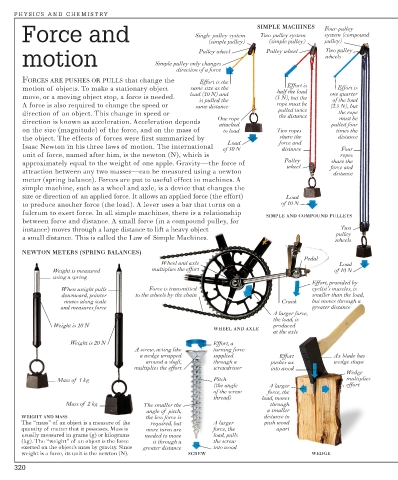
       FORCES ARE PUSHES OR PULLS that change the       Effort is the
                                                                                 Effort is
       motion of objects. To make a stationary object   same size as the      half the load    Effort is
                                                      load (10 N) and                        one quarter
       move, or a moving object stop, a force is needed.                     (5 N), but the
                                                        is pulled the                        of the load
       A force is also required to change the speed or   same distance        rope must be   (2.5 N), but
                                                                              pulled twice
       direction of an object. This change in speed or                        the distance     the rope
                                                             One rope                          must be
       direction is known as acceleration. Acceleration depends
                                                              attached                       pulled four
       on the size (magnitude) of the force, and on the mass of   to load     Two ropes       times the
       the object. The effects of forces were first summarized by              share the       distance
                                                                Load           force and
       Isaac Newton in his three laws of motion. The international
                                                               of 10 N         distance         Four
       unit of force, named after him, is the newton (N), which is                              ropes
                                                                                Pulley       share the
       approximately equal to the weight of one apple. Gravity—the force of
                                                                                 wheel       force and
       attraction between any two masses—can be measured using a newton                       distance
       meter (spring balance). Forces are put to useful effect in machines. A
       simple machine, such as a wheel and axle, is a device that changes the
       size or direction of an applied force. It allows an applied force (the effort)   Load
       to produce another force (the load). A lever uses a bar that turns on a   of 10 N
       fulcrum to exert force. In all simple machines, there is a relationship
                                                                           SIMPLE AND COMPOUND PULLEYS
       between force and distance. A small force (in a compound pulley, for
       instance) moves through a large distance to lift a heavy object                          Two
                                                                                              pulley
       a small distance. This is called the Law of Simple Machines.                           wheels
       NEWTON METERS (SPRING BALANCES)
                                                                                     Pedal
                                              Wheel and axle                                   Load
                Weight is measured         multiplies the effort                              of 10 N
                using a spring
                                                                                        Effort, provided by
                  When weight pulls       Force is transmitted                          cyclist’s muscles, is
                  downward, pointer    to the wheels by the chain                       smaller than the load,
                   moves along scale                                           Crank    but moves through a
                  and measures force                                                    greater distance
                                                                             A larger force,
                                                                             the load, is
                Weight is 10 N                                               produced
                                                            WHEEL AND AXLE
                                                                             at the axle
                     Weight is 20 N                         Effort, a
                                       A screw, acting like   turning force
                                        a wedge wrapped     supplied           Effort         Ax blade has
                                         around a shaft,    through a       pushes ax         wedge shape
                                      multiplies the effort  screwdriver    into wood
                                                                                                 Wedge
                 Mass of  1 kg                              Pitch                                multiplies
                                                            (the angle      A larger             effort
                                                            of the screw   force, the
                                                            thread)       load, moves
                   Mass of  2 kg         The smaller the                    through
                                          angle of  pitch,                 a smaller
       WEIGHT AND MASS                    the less force is               distance to
       The “mass” of an object is a measure of the   required, but   A larger   push wood
       quantity of matter that it possesses. Mass is   more turns are   force, the   apart
       usually measured in grams (g) or kilograms   needed to move   load, pulls
       (kg). The “weight” of an object is the force   it through a   the screw
       exerted on the object’s mass by gravity. Since   greater distance  into wood
       weight is a force, its unit is the newton (N).  SCREW                            WEDGE
     320

