


Page 410 - (DK) The Ultimate Visual Dictionary 2nd Ed.
P. 410
SEA AND AIR
       World War II                                              Radiator-                STARBOARD ENGINE
                                                                                                COWLINGS
                                                                 access
                                                                 cowling
       aircraft                                                Lower side-
                                                               cowling
                                                                                                  Cowling
                                                                                                  fastener
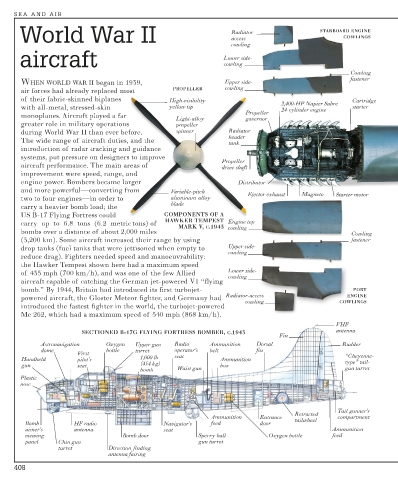
       WHEN WORLD WAR II began in 1939,                        Upper side-
       air forces had already replaced most      PROPELLER     cowling
       of their fabric-skinned biplanes         High-visibility                2,400-HP Napier Sabre   Cartridge
       with all-metal, stressed-skin            yellow tip                     24-cylinder engine  starter
                                                                     Propeller
       monoplanes. Aircraft played a far
                                                  Light-alloy        governor
       greater role in military operations        propeller
       during World War II than ever before.      spinner       Radiator
                                                                header
       The wide range of aircraft duties, and the               tank
       introduction of radar tracking and guidance
       systems, put pressure on designers to improve
                                                               Propeller
       aircraft performance. The main areas of                 drive shaft
       improvement were speed, range, and
       engine power. Bombers became larger                         Distributor
       and more powerful—converting from        Variable-pitch        Ejector exhaust  Magneto  Starter motor
       two to four engines—in order to          aluminum-alloy
                                                blade
       carry a heavier bomb load; the
       US B-17 Flying Fortress could           COMPONENTS OF A
                                               HAWKER TEMPEST   Engine top
       carry up to 6.8 tons (6.2 metric tons) of
                                                   MARK V, C.1943  cowling
       bombs over a distance of about 2,000 miles                                                  Cowling
       (3,200 km). Some aircraft increased their range by using                                    fastener
       drop tanks (fuel tanks that were jettisoned when empty to   Upper side-
                                                                cowling
       reduce drag). Fighters needed speed and manoeuvrability:
       the Hawker Tempest shown here had a maximum speed
       of 435 mph (700 km/h), and was one of the few Allied     Lower side-
                                                                cowling
       aircraft capable of catching the German jet-powered V1 “flying
       bomb.” By 1944, Britain had introduced its first turbojet-                                  PORT
                                                                Radiator-access                  ENGINE
       powered aircraft, the Gloster Meteor fighter, and Germany had
                                                                     cowling                   COWLINGS
       introduced the fastest fighter in the world, the turbojet-powered
       Me 262, which had a maximum speed of 540 mph (868 km/h).
                                                                                              VHF
                        SECTIONED B-17G FLYING FORTRESS BOMBER, C.1943                        antenna
                                                                               Fin
            Astronavigation   Oxygen   Upper gun   Radio   Ammunition    Dorsal                 Rudder
            dome              bottle   turret    operator’s   belt      fin
                      First                                                                      “Cheyenne-
       Handheld       pilot’s           1,000 lb   seat       Ammunition                         type” tail-
       gun            seat              (454 kg)              box
                                        bomb      Waist gun                                      gun turret
       Plastic
       nose


                                                                                               Tail gunner’s
                                                                                   Retracted
                                                            Ammunition   Entrance   tailwheel  compartment
        Bomb          HF radio                Navigator’s   feed         door
        aimer’s       antenna                 seat                                           Ammunition
        viewing                    Bomb door            Sperry ball         Oxygen bottle    feed
        panel    Chin gun                               gun turret
                 turret        Direction-finding-
                               antenna fairing
     408

