


Page 440 - (DK) The Ultimate Visual Dictionary 2nd Ed.
P. 440
THE VISUAL AR TS
       Watercolor                                                                   GUM ARABIC


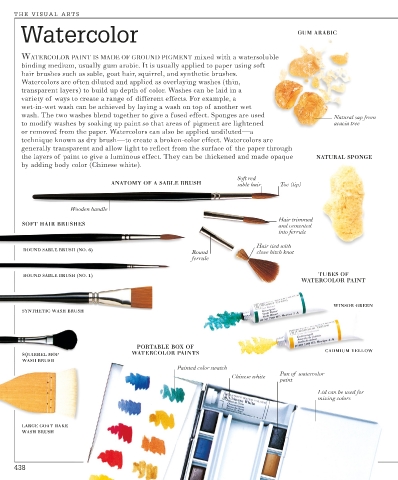
       WATERCOLOR PAINT IS MADE OF GROUND PIGMENT mixed with a water soluble
       binding medium, usually gum arabic. It is usually applied to paper using soft
       hair brushes such as sable, goat hair, squirrel, and synthetic brushes.
       Watercolors are often diluted and applied as overlaying washes (thin,
       transparent layers) to build up depth of color. Washes can be laid in a
       variety of ways to create a range of different effects. For example, a
       wet-in-wet wash can be achieved by laying a wash on top of another wet
       wash. The two washes blend together to give a fused effect. Sponges are used           Natural sap from
       to modify washes by soaking up paint so that areas of pigment are lightened            acacia tree
       or removed from the paper. Watercolors can also be applied undiluted—a
       technique known as dry brush—to create a broken-color effect. Watercolors are
       generally transparent and allow light to reflect from the surface of the paper through
       the layers of paint to give a luminous effect. They can be thickened and made opaque   NATURAL SPONGE
       by adding body color (Chinese white).
                                                                   Soft red
                                ANATOMY OF A SABLE BRUSH           sable hair  Toe (tip)


                     Wooden handle
                                                                              Hair trimmed
       SOFT HAIR BRUSHES                                                      and cemented
                                                                              into ferrule
                                                                        Hair tied with
       ROUND SABLE BRUSH (NO. 6)
                                                      Round             clove hitch knot
                                                      ferrule

       ROUND SABLE BRUSH (NO. 1)                                                         TUBES OF
                                                                                     WATERCOLOR PAINT


                                                                                              WINSOR GREEN
       SYNTHETIC WASH BRUSH


                                       PORTABLE BOX OF
                                      WATERCOLOR PAINTS                                    CADMIUM YELLOW
       SQUIRREL MOP
       WASH BRUSH
                                                  Painted color swatch
                                                                               Pan of  watercolor
                                                                 Chinese white
                                                                               paint
                                                                                         Lid can be used for
                                                                                         mixing colors


       LARGE GOAT HAKE
       WASH BRUSH


     438

