


Page 90 - (DK Eyewitness) Travel Guide - Austria
P. 90
88 VIENNA AREA B Y AREA
y Kunsthistorisches Museum
The world’s fourth largest gallery, the Museum of Art Second
History houses a collection based on works amassed over floor
the centuries by generations of Habsburg monarchs.
The public was given access to these art treasures when
two museums were built on Ringstrasse to designs by
Karl von Hasenauer and Gottfried Semper. One was to
house the art collection, a second, identical building the
Natural History Museum (see p86). Both opened in
1891. The art museum’s lavish interior comple
ments its exhibits, today seen by more than
one and a half million people each year.
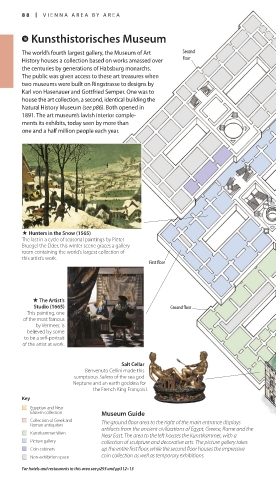
. Hunters in the Snow (1565)
The last in a cycle of seasonal paintings by Pieter
Bruegel the Elder, this winter scene graces a gallery
room containing the world’s largest collection of
this artist’s work.
First floor
. The Artist’s
Studio (1665) Ground floor
This painting, one
of the most famous
by Vermeer, is
believed by some
to be a self-portrait
of the artist at work.
Salt Cellar
Benvenuto Cellini made this
sumptuous Saliera of the sea god
Neptune and an earth goddess for
the French King François I.
Key
Egyptian and Near
Eastern collection Museum Guide
Collection of Greek and The ground floor area to the right of the main entrance displays
Roman antiquities
artifacts from the ancient civilizations of Egypt, Greece, Rome and the
Kunstkammer Wien
Near East. The area to the left houses the Kunstkammer, with a
Picture gallery collection of sculpture and decorative arts. The picture gallery takes
Coin cabinets up the entire first floor, while the second floor houses the impressive
Non-exhibition space coin collection as well as temporary exhibitions.
For hotels and restaurants in this area see p293 and pp312–13
088-089_EW_Austria.indd 88 12/09/17 2:45 pm
Eyewitness Travel LAYERS PRINTED:
Starsight template “UK” LAYER
(Source v2.8)
Date 15th May 2013
Size 125mm x 217mm

