


Page 92 - (DK Eyewitness) Travel Guide - Austria
P. 92
90 VIENNA AREA B Y AREA
Exploring the Augustea, a Roman cameo
Kunsthistorisches Museum depicting Emperor Augustus
welcoming his son Tiberius on
his return from war, together with
The Museum of Art History has a fine collection of Egyptian, Roma, the goddess of Rome.
Greek and Roman objects, which provide an intriguing record The antiquities section also
of the world’s earliest civilizations. The European sculpture and contains some Etruscan ceramics
decorative art in the Kunstkammer Wien dates from the 15th and statuettes from Tanagra.
to the 18th centuries. This period is also the focus of the picture Early Coptic, Byzantine and
gallery, which largely reflects the personal tastes of its Habsburg German items are shown in the
other rooms, but the true jewel
founders. Venetian and 17th-century Flemish paintings are well among the later antiquities is the
represented, and there is an excellent display of works by earlier Treasure of Nagyszentmiklós,
Dutch and German artists. There is also a vast coin collection. a collection of 9th-century
golden vessels with stunning
collections by Babylonian reliefs, reliefs, showing Far Eastern
Oriental and Egyptian including a glazed-brick frieze influences, found in Romania
Antiquities
depicting a striding lion from in 1799.
At the core of this collection the Ishtar Gate in Babylon and
are the objects unearthed by various exhibits from Arabia. Kunstkammer Wien
Austrian archaeologists in Giza.
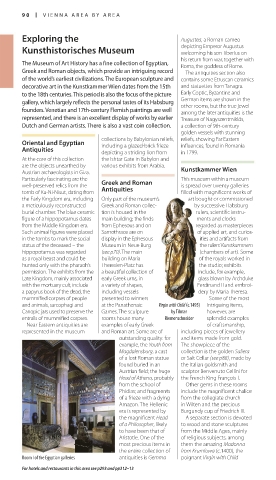
Particularly fascinating are the Greek and Roman This museum within a museum
well-preserved relics from the is spread over twenty galleries
tomb of Ka-Ni-Nisut, dating from Antiquities filled with magnificent works of
the Early Kingdom era, including Only part of the museum’s art bought or commissioned
a meticulously reconstructed Greek and Roman collec- by succes sive Habsburg
burial chamber. The blue ceramic tion is housed in the rulers, scientific instru-
figure of a hippopotamus dates main building; the finds ments and clocks
from the Middle Kingdom era. from Ephesous and on regarded as master pieces
Such animal figures were placed Samothrace are on of applied art, and curios-
in the tombs to mark the social display in the Ephesous ities and artifacts from
status of the deceased – the Museum in Neue Burg the rulers’ Kunstkammern
hippopotamus was regarded (see p70). The main (chambers of art). Some
as a royal beast and could be building on Maria- of the royals worked in
hunted only with the pharaoh’s Theresien-Platz has the studio; exhibits
permission. The exhibits from the a beautiful collection of include, for example,
Late Kingdom, mainly associated early Greek urns, in glass blown by Archduke
with the mortuary cult, include a variety of shapes, Ferdinand II and embroi-
a papyrus book of the dead, the including vessels dery by Maria Theresa.
mummified corpses of people presented to winners Some of the most
and animals, sarcophagi and at the Panathenaic Virgin with Child (c.1495) intriguing items,
Canopic jars used to preserve the Games. The sculpture by Tilman however, are
entrails of mummified corpses. rooms house many Riemenschneider splendid examples
Near Eastern antiquities are examples of early Greek of crafts manship,
represented in the museum and Roman art. Some are of including pieces of jewellery
outstanding quality: for and items made from gold.
example, the Youth from The show piece of the
Magdalensburg, a cast collection is the golden Saliera
of a lost Roman statue or Salt Cellar (see p88), made by
found buried in an the Italian gold smith and
Austrian field; the huge sculptor Benvenuto Cellini for
Head of Athena, probably the French King François I.
from the school of Other gems in these rooms
Phidias; and fragments include the magnificent chalice
of a frieze with a dying from the collegiate church
Amazon. The Hellenic in Wilten and the precious
era is represented by Burgundy cup of Friedrich III.
the magnificent Head A separate section is devoted
of a Philosopher, likely to wood and stone sculptures
to have been that of from the Middle Ages, mainly
Aristotle. One of the of religious subjects, among
most precious items in them the amazing Madonna
the entire collection of from Krumlowa (c.1400), the
Room I of the Egyptian galleries antiquities is Gemma poignant Virgin with Child
For hotels and restaurants in this area see p293 and pp312–13
090-091_EW_Austria.indd 90 12/09/17 3:02 pm
Eyewitness Travel LAYERS PRINTED:
Flashmap follow-on template “UK” LAYER
(Source v1.5)
Date 7th January 2013
Size 125mm x 217mm

