


Page 25 - History of War - Issue 18-15
P. 25
Frontline
             THEBIRTHOFIRONCLADS


            As cannonballs from coastal batteries began to destroy                                Maurice Hutty is the chairman of the HMS
                                                                                                Warrior Association and has been a volunteer
            wooden navies, iron was introduced to turn the tide                                       guideaboardthevesselsince1993

            WHY AND HOW DID IRON        carbon content, but engineer   backed by 46 centimetres (18   the iron needed in great quantities.
            REPLACE WOOD, AND           and scientist Henry Bessemer   inches) of wood. The thickness of   Britain was far ahead of other nations
            STEAM REPLACE SAIL ON       developed a way to remove the   the iron was determined by the   in this respect, and had by far the
            THE WORLD’S WARSHIPS?       carbon by blowing compressed air   machinery available to manufacture   largest ironclad fl eet in the world.
            Iron started to be used in warship   into the molten iron.   it at that time. Ships could hold   However, the Royal Navy still kept a
            construction in the 1700s in the                         bigger and heavier guns but until   massive fl eet of wooden ships until
            form of joint brackets. Timber was   WHO INVENTED THE    stronger explosives than gunpowder   their life expired.
            getting very short in Britain’s forests  IRONCLAD WARSHIP?  became available, then there was
            and demand was struggling to keep   During the Crimean War, both the   no need for larger guns.  HOW MUCH OF A TURNING
            up with supply for a small country   French and English ships suffered               POINT WAS THE BATTLE OF
            with a very large navy.     causalities from bombardments   HOW IMPORTANT WAS        HAMPTON ROADS?
              Steam replacing sail was a   by shore batteries. The French   THE CONSTRUCTION AND   The Battle of Hampton Roads in the
            natural progression once the steam   responded by producing some small  LAUNCH OF HMS WARRIOR   American Civil War goes down in
            engine had been invented. First   boats made of wood but protected   TO MARITIME WARFARE?  the history books as the fi rst clash
            designed to pump water out of   by iron plates. Cannonballs could   Warrior was built with one purpose   between two ironclads. The Union
            mines in the early 1700s, steam   not penetrate the ships’ iron sides,   in mind, to repel France, one of the   Monitor engaged the Confederate
            engines found their way on to ships   making the designers realise that   strongest military countries in the   ship Virginia in a battle that lasted
            in the 1820s. The mine engines   the shockwave produced when a   world. Plans to invade Britain by the   four hours. Virginia was hit 50 times
            used a large revolving wheel with   cannonball hit the iron side of the   French were put in place from 1856   while Monitor, a much smaller ship
            buckets to move the water, so when   ship was absorbed by the wood and   and the ship was built to deter this   that lay much lower in the water, was
            engines were placed on ships,   no damage was done. The era of   threat. It could operate in any part   hit 21 times. The battle ended when
            the buckets gave way to planks of   the ironclad was born.             of the world, so should any other   the Monitor’s captain was temporarily
            wood to propel the ship. Although                        nation have similar ideas, they   blinded and broke his ship off from
            naval offi cers initially disliked steam  HOW DID NAVAL BATTLES   knew they would have to overcome   the confl ict. Virginia’s captain thought
            engines, they soon found their ships  CHANGE WITH THESE NEW   Warrior fi rst.        that Monitor was in retreat and did
            were now free of the restrictions of   SHIPS? COULD THEY HOLD                        not pursue, ending the fi rst ironclad
            tide and wind direction, giving them  BIGGER AND HEAVIER   WHICH COUNTRIES           battle in a draw.
            a freedom they never had before.   NAVAL GUNS?           TOOK TO IRONCLAD SHIP
              Steel ship building was not   The ironclads all used roughly the   PRODUCTION THE MOST?  DID THE FIRST IRONCLAD
            possible before the 1870s, as   same thickness of armour: 11.5   Ironclads could only be built by   SHIPS HAVE ANY
            molten iron contained a large   centimetres (4.5 inches) of iron   countries with the ability to produce  MECHANICAL ISSUES?
                                                                                                 Warrior, the fi rst of the British
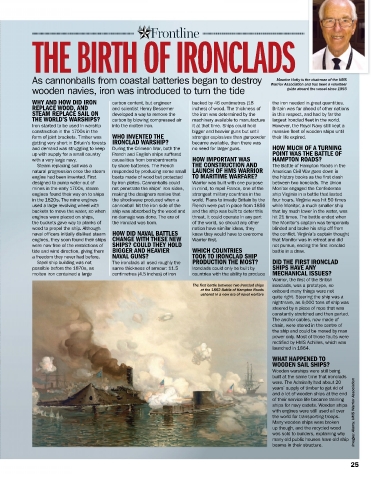
                                                                     ThefirstbattlebetweentwoIroncladships  ironclads, was a prototype, so
                                                                        atthe1862BattleofHamptonRoads  onboard many things were not
                                                                        usheredinaneweraofnavalwarfare
                                                                                                 quite right. Steering the ship was a
                                                                                                 nightmare, as 9,000 tons of ship was
                                                                                                 steered by a piece of rope that was
                                                                                                 constantly stretched and then parted.
                                                                                                 The anchor cables, now made of
                                                                                                 chain, were stored in the centre of
                                                                                                 the ship and could be moved by man
                                                                                                 power only. Most of those faults were
                                                                                                 rectifi ed by HMS Achilles, which was
                                                                                                 launched in 1864.
                                                                                                 WHAT HAPPENED TO
                                                                                                 WOODEN SAIL SHIPS?
                                                                                                 Wooden warships were still being
                                                                                                 built at the same time that ironclads
                                                                                                 were. The Admiralty had about 20
                                                                                                 years’ supply of timber to get rid of
                                                                                                 and a lot of wooden ships at the end
                                                                                                 of their service life became training
                                                                                                 ships for navy cadets. Wooden ships
                                                                                                 with engines were still used all over  Images: Alamy, HMS Warrior Association
                                                                                                 the world for transporting troops.
                                                                                                 Many wooden ships were broken
                                                                                                 up though, and the recycled wood
                                                                                                 was sold to builders, explaining why
                                                                                                 many old public houses have old ship
                                                                                                 beams in their structure.


                                                                                                                            25

