


Page 29 - History of War - Issue 18-15
P. 29
THE UNSUNG HEROES OF THE BATTLE OF BRITAIN


            English. The French method of spreading Polish
            pilots through existing squadrons would be
            problematic in the RAF, but that was how the   THE PURSUIT BRIGADE
            fi rst men to arrive made their contributions.
              Some of those who had moved on to Britain
            soon after reaching France were already in   HOWTHEPOLISHAIRFORCETOOKTHEFIRSTFIGHTTOTHELUFTWAFFEIN1939
            training. Fighter aces were even prepared to   Oneofthemythsofthewar,propagatedbythe  Operatingfromabaseaboutfivekilometres
            take up posts in bomber squadrons, so keen   Nazis,wasthatthePolishAirForcehadbeen  northeastofWarsaw,III/1Dywizjoncomprised
            were they to keep fi ghting. This enthusiasm   destroyedonthegroundinthefirsttwodays  111 and 112 Eskadras. The famed 303 Squadron
            led to one of the many myths about the Polish   oftheGermaninvasion.Infact,thePoleshad  would largely be made up of pilots from this unit.
            Air Force – that their personnel were brave but   knownwhatwascomingandhadmovedtheir  Most of the pilots in the Pursuit Brigade flew PZL
            reckless, and that they paid a heavy price for it.  fighterstonewbasesbeforetheNazisstruck.  P.11 fighter aircraft, although 123 Eskadra had
              The Polish fi ghters were indeed brave, and   The problem was that those fighters were badly  tomakedowithP.7s.Lessthanadecadeold
            their preferred tactic – closing to extremely   outperformed by their German counterparts and  when the war opened, the P.11 had nevertheless
            close range before opening fi re on an enemy –   evenstruggledtocompetewithbombers.  been rendered nearly obsolete by modern
            appeared to the British to be quixotic.   The Pursuit Brigade (Brygada Poscigowa) was  developmentsinfightertechnology.Ithada
              It would take some time for this     comprisedoftwosquadronsresponsiblefor  distinctlyold-worldlook,withitsopencockpitand
            misapprehension to be remedied and for the   defending Warsaw. Three units, 113, 114 and  fixed undercarriage.
            Polish airmen to be recognised for what they   123 Eskadras, made up IV/1 Dywizjon (Squadron),  UnabletocatchGermanplanesfrombehind
            were – some of the best pilots available to   based about 11 kilometres north of Warsaw.  (itstopspeedwasjust242milesperhour),P.11
            the RAF. Their experience was valued from the                              pilots were forced to tackle them head-on, and
            start, but it was with British units that they                             therelativeweaknessoftheP.11armament(two
            made their fi rst contributions.       “THE P.11 HAD BEEN                  or four 7.92mm machine guns) meant that they
              Of course, their support was badly needed.                               hadtoclosetothesortofrangesthatwouldhave
            Britain, anticipating a major air confrontation   RENDERED NEARLY          made an RAF pilot blanche to have a chance of
            with Germany, had been investing heavily in                                downing an enemy.
            its air force since 1937, but when war came,   OBSOLETE BY MODERN            Seriouslyoutnumberedaswell,itisnosurprise
            it did not follow the expected pattern. German                             thatthePAFlostabout85percentofitsaircraft
            military planning was not based on massive   DEVELOPMENTS IN               during Poland’s brief war, but it also claimed
            strikes from the air, but on tight co-operation                            more than 100 kills, and the experience gained
            between air and land forces. The nightmare of   FIGHTER TECHNOLOGY”        by the pilots was to prove invaluable in France
            bombing raids against cities was not part of the                           and Britain.
            plan – it was only to be considered in retaliation
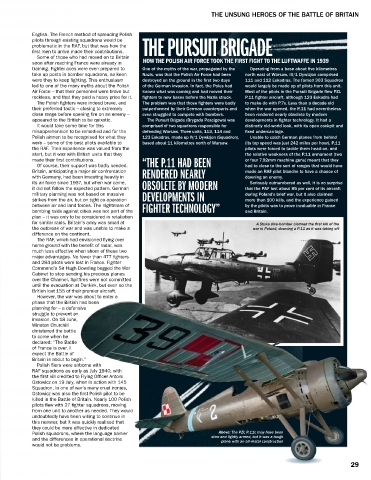
            for similar raids. Britain’s army was small at                                 A Stuka dive-bomber claimed the first kill of the
            the outbreak of war and was unable to make a                                  warinPoland,downingaP.11asitwastakingoff
            difference on the continent.
              The RAF, which had envisioned fl ying over
            home ground with the benefi t of radar, was
            much less effective when shorn of these two
            major advantages. No fewer than 477 fi ghters
            and 284 pilots were lost in France. Fighter
            Command’s Sir Hugh Dowding begged the War
            Cabinet to stop sending his precious planes
            over the Channel. Spitfi res were not committed
            until the evacuation at Dunkirk, but even so the
            British lost 155 of their premier aircraft.
              However, the war was about to enter a
            phase that the British had been
            planning for – a defensive
            struggle to prevent an
            invasion. On 18 June,
            Winston Churchill
            christened the battle
            to come when he
            declared: “The Battle
            of France is over. I
            expect the Battle of
            Britain is about to begin.”
              Polish fl iers were airborne with
            RAF squadrons as early as July 1940, with
            the fi rst kill credited to Flying Offi cer Antoni
            Ostowicz on 19 July, when in action with 145
            Squadron. In one of war’s many cruel ironies,
            Ostowicz was also the fi rst Polish pilot to be
            killed in the Battle of Britain. Nearly 100 Polish
            pilots fl ew with 27 fi ghter squadrons, moving
            from one unit to another as needed. They would
            undoubtedly have been willing to continue in
            this manner, but it was quickly realised that
            they could be more effective in dedicated
            Polish squadrons, where the language barrier                      Above: ThePZLP.11cmayhavebeen
                                                                           slow and lightly armed, but it was a tough
            and the differences in operational doctrine
                                                                               plane with an all-metal construction
            would not be problems.
                                                                                                                            29

