


Page 28 - History of War - Issue 18-15
P. 28
303 SQUADRON


          Rising from Poland’s ashes           ‘Montpelier Squadron’ (so called because
          The Polish Air Force (PAF) was reorganised just   that was where they had undertaken their
          prior to the outbreak of hostilities in September   conversion courses for the MS.406), which was
          1939, with the bulk of the eskadras (escadrilles  divided between several French formations.
          or flights, which were grouped together into   The willingness of the Polish to fi ght wherever
          squadrons) being allocated to Polish land   and whenever was exemplifi ed by a squadron
          forces. The exception was the Brygada   that trained in France in order to fi ght against
          Poscigowa, the ‘Pursuit Brigade’, which was   the Russians in Finland. Before they could be
          tasked with defending Warsaw.        transferred, however, the Finns made their
           Despite the technological inferiority of its   separate peace with the Soviet Union on 12
          machines, the PAF downed more than 100   March 1940. Even after being asked to fl y
          German planes and Pilot Offi cer Stanisław   the inferior Caudron-Renault C.714 Cyclone, a
          Skalski of 142 Eskadra became the fi rst Allied   seriously underpowered plane with a wooden
          ‘ace’ of the war, downing four German planes   frame, the Polish pilots stubbornly persevered.
          and sharing in the destruction of a fi fth.  French authorities declared the plane unfi t for
           As the Polish armed forces fell back before   combat after early negative feedback, but with
          the German advance, they could count on the   no alternatives available, the pilots fl ew on.
          forests and marshland in eastern Poland to   Of course, the end of this chapter came
          slow their enemy down on the ground, while new  quickly. Having been credited with the
          planes (including Hurricanes) were expected   destruction of 60 German planes (at a cost
          to arrive via neutral Romania at any moment   of 13 pilots killed), the Polish airmen were on
          to match the Germans in the air. Such hope   the move once more after France surrendered.
          was dashed on 17 September, when the Soviet   Scattering in any planes they could get their
          Union invaded Poland from the east. The next   hands on, or making their way to French ports,
          day, the remaining PAF forces were ordered to   the men headed for Marseilles, La Rochelle,
          make their way as best they could to Romania   North Africa and Gibraltar. Their routes may have
          or Hungary. It was to be just the fi rst step of   been varied, but their destination was always
          alongjourney.Fromtheir temporary havens,   the same – as far as they were concerned, there
          the Polish pilots headed for France, mostly   was simply nowhere else to go.
          by ship (the few P.11s that had been fl own to
          Romania were left there), and quickly started   The island of last hope
          preparations for the next stage of their war.  The Polish airmen had put up a brave fi ght in
           Some Polish forces, perhaps recognising the   their homeland and in France, and they could
          likelihood of German success in France, headed  have headed for the USA or Canada with
          immediately for Britain. However, most, pilots   pride intact. But only one nation still offered
          and air crew alike, started frantic retraining   the prospect of continued combat operations
          on the Morane-Saulnier MS.406 – a plane   against the Germans.
          with a passing resemblance to the Hurricanes   Despite this, Britain was a very different
          the men of 303 Squadron would fl y with such   experience for the Poles. Where they had
          distinction during the Battle of Britain.   enjoyed their own ‘special relationship’ with
           A total of 130 Polish pilots took part in the   the French, which meant that most of them
          Battle of France, with many serving in the  spoke excellent French, they had little or no

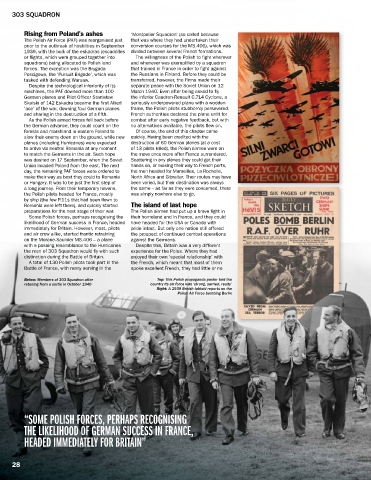
          Below: Members of 303 Squadron after          Top: This Polish propaganda poster told the
          retuning from a sortie in October 1940      country its air force was ‘strong, serried, ready’
                                                        Right: A 1939 British tabloid reports on the
                                                               Polish Air Force bombing Berlin


          “SOME POLISH FORCES, PERHAPS RECOGNISING

          THE LIKELIHOOD OF GERMAN SUCCESS IN FRANCE,
          HEADED IMMEDIATELY FOR BRITAIN”


     28

