


Page 25 - Mammal (DK Eyewitness)
P. 25
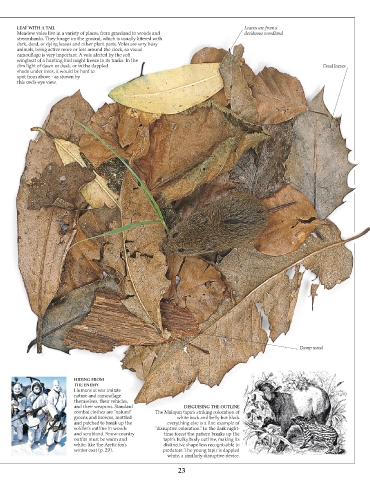
LEAF WITH A TAIL                                                           Leaves are from a
       Meadow voles live in a variety of places, from grassland to woods and      deciduous woodland
       streambanks. They forage on the ground, which is usually littered with
       dark, dead, or dying leaves and other plant parts. Voles are very busy
       animals, being active more or less around the clock, so visual
       camouflage is very important. A vole alerted by the soft
       wingbeat of a hunting bird might freeze in its tracks. In the
       dim light of dawn or dusk, or in the dappled                                                         Dead leaves
       shade under trees, it would be hard to
       spot from above - as shown by
       this owl’s-eye view.


                                                                                                    Damp wood


                          HIDING FROM
                          THE ENEMY
                          Humans at war imitate
                          nature and camouflage
                          themselves, their vehicles,
                          and their weapons. Standard         DISGUISING THE OUTLINE
                          combat clothes are “natural”   The Malayan tapir’s striking coloration of
                          greens and browns, mottled        white back and belly but black
                          and patched to break up the   everything else is a fine example of
                          soldier’s outline in woods   “disruptive coloration.” In the dark night-
                          and scrubland. Snow-country   time forest the pattern breaks up the
                          outfits must be warm and     tapir’s bulky body outline, making its
                          white, like the Arctic fox’s   distinctive shape less recognizable to
                          winter coat (p. 29).         predators. The young tapir is dappled
                                                        white, a similarly disruptive device.
                                                            23


 (c) 2011 Dorling Kindersley. All Rights Reserved.

