


Page 28 - Mammal (DK Eyewitness)
P. 28
Designs for defense

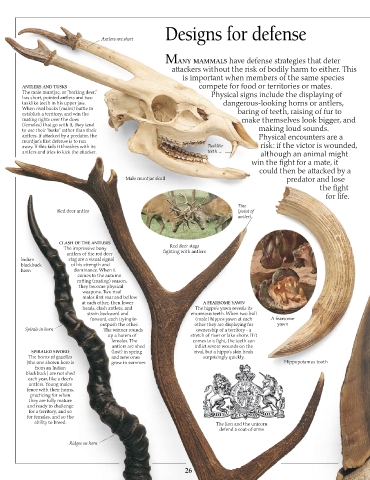
                                   Antlers are short


                                                        Many mammals have defense strategies that deter
                                                          attackers without the risk of bodily harm to either. This
                                                             is important when members of the same species
        ANTLERS AND TUSKS                                          compete for food or territories or mates.
        The male muntjac, or “barking deer,”                           Physical signs include the displaying of
        has short, pointed antlers and two
        tusklike teeth in his upper jaw.                                   dangerous-looking horns or antlers,
        When rival bucks (males) battle to                                      baring of teeth, raising of fur to
        establish a territory, and win the
        mating rights over the does                                              make themselves look bigger, and
        (females) that go with it, they tend
        to use their “tusks” rather than their                                         making loud sounds.
        antlers. If attacked by a predator, the                                        Physical encounters are a
        muntjac’s first defense is to run
        away. If this fails it thrashes with its                      Tusklike         risk: if the victor is wounded,
        antlers and tries to kick the attacker.                       teeth            although an animal might
                                                                                    win the fight for a mate, it
                                                                                       could then be attacked by a
                                           Male muntjac skull                                   predator and lose
                                                                                                           the fight
                                                                                                             for life.
                                                                                Tine
                    Red deer antler                                             (point of
                                                                                antler)


                     CLASH OF THE ANTLERS
                      The impressive bony                Red deer stags
                       antlers of the red deer         fighting with antlers
        Indian          stag are a visual signal
        blackbuck        of his strength and
        horn              dominance. When it
                           comes to the autumn
                           rutting (mating) season,
                           they become physical
                            weapons. Two rival
                            males first roar and bellow
                            at each other, then lower               A FEARSOME YAWN
                            heads, clash antlers, and             The hippo’s yawn reveals its
                              strain backward and               enormous teeth. When two bull
                               forward, each trying to            (male) hippos yawn at each   A fearsome
                                  outpush the other.             other they are displaying for   yawn
         Spirals in horn           The winner rounds              ownership of a territory - a
                                     up a harem of              stretch of river or lake shore. If it
                                      females. The               comes to a fight, the teeth can
                                      antlers are shed           inflict severe wounds on the
           SPIRALED SWORD             (lost) in spring           rival, but a hippo’s skin heals
          The horns of gazelles       and new ones                  surprisingly quickly.
          (the one shown here is      grow in summer.                                          Hippopotamus tooth
             from an Indian
          blackbuck) are not shed
          each year, like a deer’s
           antlers. Young males
          fence with their horns,
           practicing for when
           they are fully mature
          and ready to challenge
           for a territory, and so
          for females, and so the
            ability to breed.                                           The lion and the unicorn
                                                                          defend a coat-of-arms

                        Ridges on horn


                                                              2


 (c) 2011 Dorling Kindersley. All Rights Reserved.

