


Page 27 - Mammal (DK Eyewitness)
P. 27
STRANGE BEHAVIOR
                                                                                                    Hedgehogs have often
                                                                                                    been seen to chew
                                                                                                    something foul (such
                                                                                                    as the dead toad, left),
                                                                                                    and then flick and spit
                                                                                                    their frothy saliva over
                                                                                                    their spines. It is not
                                                                                                    clear why. One theory
                                                                                                    is that this self-
                                                                                                    anointing is part of the
                                                                                                    animal’s defense,
                                                                                                    helping to deter
                                                                                                    predators.

                                                                          BABY’S DEFENSE
                                                                          A baby hedgehog’s
                                                                          first coat of rubbery
                                                                          spines lies flat under
                                                                          its skin at birth, but
                                                                          pops up within a few
                                                                          hours. The baby
                                                                          cannot roll up until
                                                                          it is 11 days old. Its
                      Feet barely visible
                                                                          main defense is
                                                                           to jerk its head up-
                         Head remains tucked under                           wards, stabbing
                                                                               predators on
                                                                                  the nose.
         FLIPOVER
          f
         I
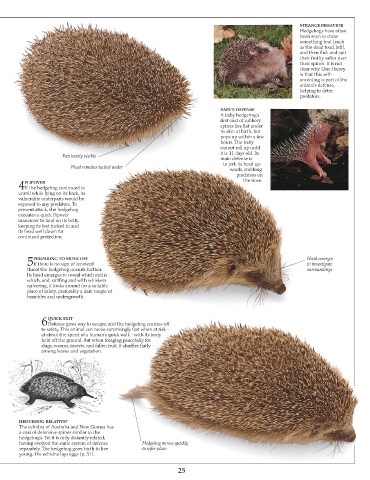
       4  the hedgehog continued to
       unroll while lying on its back, its
       vulnerable underparts would be
       exposed to any predators. To
       prevent attack, the hedgehog
       executes a quick flipover
       maneuver to land on its belly,
       keeping its feet tucked in and
       its head well down for
       continued protection.

            PREPARING TO MOVE OFF                                                                      Head emerges
            I
             f
          5  there is no sign of renewed                                                               to investigate
          threat the hedgehog uncurls further.                                                         surroundings
          Its head emerges to reveal which end is
          which, and, sniffing and with whiskers
          quivering, it looks around for a suitable
          place of safety, preferably a dark tangle of
          brambles and undergrowth.

                 QUICK EXIT
               6  Defense gives way to escape, and the hedgehog scurries off
               to safety. This animal can move surprisingly fast when at risk -
               at about the speed of a human’s quick walk - with its body
               held off the ground. But when foraging peacefully for
               slugs, worms, insects, and fallen fruit, it shuffles flatly
               among leaves and vegetation.


       HEDGEHOG RELATIVE?
       The echidna of Australia and New Guinea has
       a coat of defensive spines similar to the
       hedgehog’s. Yet it is only distantly related,
       having evolved the same system of defense   Hedgehog moves quickly
       separately. The hedgehog gives birth to live   to safer place
       young; the echidna lays eggs (p. 31).

                                                            25


 (c) 2011 Dorling Kindersley. All Rights Reserved.

