


Page 32 - Mammal (DK Eyewitness)
P. 32
An early birth


                                    Most mammals develop in their
                                    mother’s womb (uterus). When born
                                    they are well formed, and in many
                                    species they are up and about within
                                    hours of birth (p. 35). Pouched
                                    mammals, or marsupials, don’t
                                    follow this system. What sets
                                    them apart from all other
                                    mammals is the way
            Australian marsupials
                                    they reproduce. The
        Eastern gray kangaroo is a typical example: its
        baby grows for only five weeks in the womb.
        When born it is just 1 in (2.5cm) long, naked,
        blind, and unrecognizable as a kangaroo
        (see opposite). It wriggles from the birth
        opening (which is not the same as the birth
        canal of other mammals, p. 35) to the teat
        (nipple) in the mother’s pouch. As it
        takes the teat in its mouth and sucks,
        the teat swells and the baby is “stuck”
        there as it continues to grow and
        develop. The pouch, therefore, acts as
        a sort of external womb where the
        baby continues its development. After
        a while the baby’s jaws enlarge and it
        can let go of the teat. Later it grows
        enough to leave the pouch for short
        periods. After about 10 months the
                                      youngster is too
                                         big to get into
                                             the pouch.


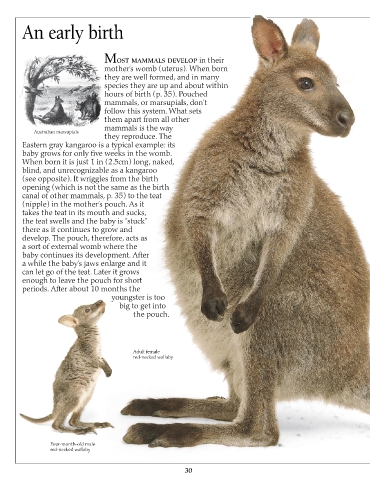
                                             Adult female
                                             red-necked wallaby


                  Four-month-old male
                  red-necked wallaby


                                                              30


 (c) 2011 Dorling Kindersley. All Rights Reserved.

