


Page 38 - Mammal (DK Eyewitness)
P. 38
Unique to mammals


                                   The mammary glands, unique to the
                                   mammalian mother, form in the skin.
                                   They resemble specialized sweat
                                   glands and grow in two milk lines
                                   on each side of the abdomen.
                                   Cats and dogs have several
                                   glands and teats along each
        A mare has two teats between her   side; in hoofed animals
        back legs. She nudges her foal
        toward them; the foal then feeds   they are near the
        on average about 4 times each hour.
                                   hind legs. In
        primates (including humans) they are on
        the chest, a site that may be connected
        with adaptation to a tree-dwelling life
        and the consequent need to hold the
        babies with the forelimbs. During
        pregnancy, the mammary glands
        increase in size under the
        influence of the female hormones
        estrogen and progesterone. Milk
        production is stimulated by
        another hormone, prolactin.
        After birth a hormone
        called oxytocin, from
        the pituitary gland (just
        under the brain),
        causes the gland to
        release its milk and
        encourages formation of more
        milk. Milk is the young mammal’s
        complete food, providing even
        the water it needs.


        THE NEAT TEAT
        Unlike kittens, puppies usually feed from
        whichever teat they can find. The teat is a
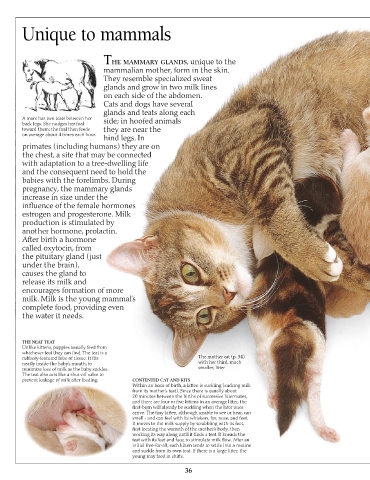
        rubbery-textured lobe of tissue. It fits                   The mother cat (p. 34)
        neatly inside the baby’s mouth, to                         with her third, much
        minimize loss of milk as the baby suckles.                 smaller, litter
        The teat also acts like a shut-off valve to
        prevent leakage of milk after feeding.  CONTENTED CAT AND KITS
                                             Within an hour of birth, a kitten is suckling (sucking milk
                                             from its mother’s teat). Since there is usually about
                                             20 minutes between the births of successive littermates,
                                             and there are four or five kittens in an average litter, the
                                             first-born will already be suckling when the later ones
                                             arrive. The tiny kitten, although unable to see or hear, can
                                             smell - and can feel with its whiskers, fur, nose, and feet.
                                             It moves to the milk supply by scrabbling with its feet,
                                             first locating the warmth of the mother’s body, then
                                             working its way along until it finds a teat. It kneads the
                                             teat with its feet and face, to stimulate milk flow. After an
                                             initial free-for-all, each kitten tends to settle into a routine
                                             and suckle from its own teat. If there is a large litter, the
                                             young may feed in shifts.
                                                              3


 (c) 2011 Dorling Kindersley. All Rights Reserved.

