


Page 50 - Mammal (DK Eyewitness)
P. 50
How to deal with a meal


                                          A large, cold-blooded animal such as a
                                          snake may go for weeks without eating.
                                          But mammals, being active and warm-
                                          blooded, need lots of energy to keep them
                                          going. Energy, as well as the raw materials
                                          for growth and reproduction and body main-
        Three-course meal: house mice make short
        work of cream, bulbs, and candle wax   tenance, comes from food. Feeding is therefore
        during their nightly trips to the kitchen.  vital to life. In modern society, humans spend relatively
        little time hunting for food. It may take what seems like all day to go around the super-
        market, but we have lost sight of how most wild mammals build their daily routine around
        finding enough to eat. One of the reasons for the mammal’s high energy requirements is the
        ability to be active in cold conditions, when the cold-bloodeds are chilled and slow. This may
        be why much mammalian food-hunting is done at dawn and dusk, before the heat of the day
        allows reptiles, insects, and other cold-blooded prey to warm up and dart away. The smaller
        the mammal, the more feeding it has to do, since small bodies have proportionally more
        surface area than large ones, and so lose heat at a greater rate. In cooler climates, the smallest
        mammals have only just enough hours in the day to feed themselves. Shrews do little else
        except feed in a frenzy, then rest and digest, then feed again. They eat their own body weight
        in food each day, and can starve to death in only three hours. At the other end of the meat-
                                             eater scale, the lion needs only
                                             the equivalent of about
        TREE-TOP TONGUE                      1/40th of its body weight in food
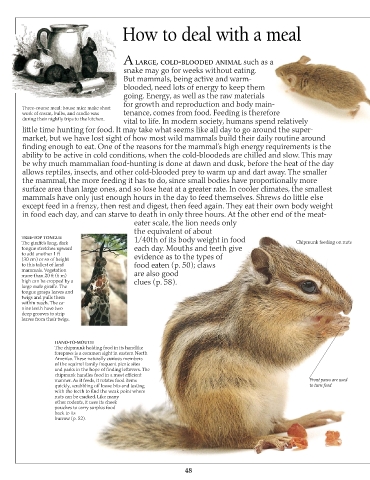
        The giraffe’s long, dark                                                                   Chipmunk feeding on nuts
        tongue stretches upward              each day. Mouths and teeth give
        to add another 1 ft                  evidence as to the types of
        (30 cm) or so of height
        to this tallest of land              food eaten (p. 50); claws
        mammals. Vegetation                  are also good
        more than 20 ft (6 m)
        high can be cropped by a             clues (p. 58).
        large male giraffe. The
        tongue grasps leaves and
        twigs and pulls them
        within reach. The ca-
        nine teeth have two
        deep grooves to strip
        leaves from their twigs.


                   HAND-TO-MOUTH
                   The chipmunk holding food in its handlike
                   forepaws is a common sight in eastern North
                   America. These naturally curious members
                   of the squirrel family frequent picnic sites
                   and parks in the hope of finding leftovers. The
                   chipmunk handles food in a most efficient
                   manner. As it feeds, it rotates food items                                           Front paws are used
                   quickly, scrabbling off loose bits and testing                                       to turn food
                   with the teeth to find the weak point where
                   nuts can be cracked. Like many
                   other rodents, it uses its cheek
                   pouches to carry surplus food
                   back to its
                   burrow (p. 52).


                                                              4


 (c) 2011 Dorling Kindersley. All Rights Reserved.

