


Page 54 - Mammal (DK Eyewitness)
P. 54
Food for later


                                    Few habitats in the world provide a constant, year-round supply of
                                    food. Our distant ancestors recognized this, and they understood the
                                    need to build up a store for later. Planning ahead by planting crops and
                                    storing fruits led to the beginnings of agriculture some 10,000 years
                                    ago. Other mammals, however, have probably been saving food in
         times of plenty, to be eaten when times are hard, for millions of years. Seeds a favorite. In a seed,
         the parent plant has provided a rich store of nutrients that the embryo (baby) plant will rely on
         when it germinates. The seed is therefore a ready-packed, nutritious meal. In return, the seed
         storers help the plant. An animal that buries seeds and then forgets about them has helped the
         plant to spread. Meat is more of a problem, since it tends to decay, but burying is still worthwhile
         for mammals such as foxes. With its legendary cunning the fox does not store all its surplus food
         in one place. It makes several stores in different places, so that if another animal discovers one
         store, the fox does not lose the lot.


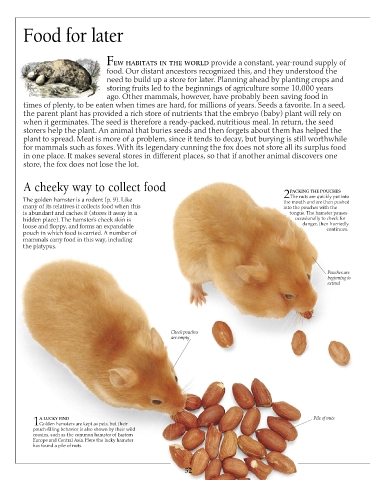
         A cheeky way to collect food                                                            PACKING THE POUCHES

                                                                                                 T
         The golden hamster is a rodent (p. 9). Like                                           2 he nuts are quickly put into
                                                                                               the mouth and are then pushed
         many of its relatives it collects food when this                                      into the pouches with the
         is abundant and caches it (stores it away in a                                          tongue. The hamster pauses
         hidden place). The hamster’s cheek skin is                                                occasionally to check for
         loose and floppy, and forms an expandable                                                   danger, then hurriedly
         pouch in which food is carried. A number of                                                         continues.
         mammals carry food in this way, including
         the platypus.


                                                                                                             Pouches are
                                                                                                             beginning to
                                                                                                             extend


                                                          Cheek pouches
                                                          are empty


              A LUCKY FIND                                                                               Pile of nuts
            1 Golden hamsters are kept as pets, but their
            pouch-filling behavior is also shown by their wild
            cousins, such as the common hamster of Eastern
            Europe and Central Asia. Here the lucky hamster
            has found a pile of nuts.


                                                              52


 (c) 2011 Dorling Kindersley. All Rights Reserved.

