


Page 52 - Mammal (DK Eyewitness)
P. 52
Grippers and grinders                                                                            Black bear skull


        Mammals, being warm-blooded and generally
        active, need to take in plenty of food to pro-
        vide sufficient energy for life. The jaws and
        teeth are at the forefront of feeding: they
        grasp the food, cut it into smaller pieces if
        necessary, and do some preliminary
        crushing and grinding before it is
        swallowed. The basic structure of the
        mammalian tooth is a soft inside containing
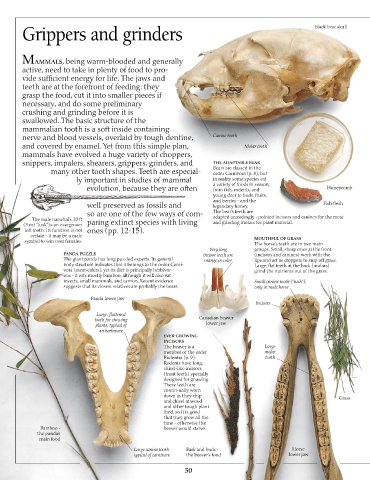
        nerve and blood vessels, overlaid by tough dentine,            Canine tooth
        and covered by enamel. Yet from this simple plan,                         Molar tooth
        mammals have evolved a huge variety of choppers,
        snippers, impalers, shearers, grippers, grinders, and           THE ADAPTABLE BEAR
                  many other tooth shapes. Teeth are especial-          Bears are classed in the
                                                                        order Carnivora (p. 8), but
                          ly important in studies of mammal             in reality some species eat
                              evolution, because they are often         a variety of foods in season,        Honeycomb
                                                                        from fish, rodents, and
                                                                        young deer to buds, fruits,
                                                                        and berries - and the
                              well preserved as fossils and             legendary honey.                    Fish flesh
                              so are one of the few ways of com-        The bear’s teeth are
            The male narwhal’s 10 ft   paring extinct species with living   adapted accordingly - pointed incisors and canines for the meat
         (3 m) “tusk” is an overgrown                                   and grinding molars for plant material.
         left tooth. Its function is not   ones (pp. 12-15).
           certain - it may be a male
         symbol to win over females.                                                 MOUTHFUL OF GRASS
                                                                                     The horse’s teeth are in two main
                                                                      Very long      groups. Small, sharp ones at the front
                      PANDA PUZZLE                                  incisor teeth are   (incisors and canines) work with the
                      The giant panda has long puzzled experts. Its general   orange in color  lips and act as croppers to snip off grass.
                      body structure indicates that it belongs to the order Carni-   Large, flat teeth at the back (molars)
                      vora (meat-eaters), yet its diet is principally herbivor-      grind the nutrients out of the grass.
                      ous - it eats mostly bamboo, although it will also eat
                      insects, small mammals, and carrion. Recent evidence           Small canine tooth (“tush”),
                      suggests that its closest relatives are probably the bears.    only in male horse

                               Panda lower jaw
                                                                                      Incisors
                                 Large, flattened
                                tooth for chewing                  Canadian beaver
                                 plants, typical of                  lower jaw
                                  an herbivore
                                                       EVER-GROWING
                                                       INCISORS
                                                       The beaver is a                   Large
                                                       member of the order               molar
                                                       Rodentia (p. 9).                  tooth
                                                       Rodents have long,
                                                       chisel-like incisors
                                                       (front teeth) specially
                                                       designed for gnawing.
                                                       These teeth are
                                                       contin-ually worn
                                                       down as they chip                                         Grass
                                                       and chisel at wood
                                                       and other tough plant
                                                       food, so it is good
                                                       that they grow all the
                                                       time - otherwise the
              Bamboo -                                 beaver would starve.
             the panda’s
              main food
                                             Large canine tooth   Bark and buds -                 Horse
                                             typical of carnivore  the beaver’s food             lower jaw

                                                              50


 (c) 2011 Dorling Kindersley. All Rights Reserved.

