


Page 65 - Mammal (DK Eyewitness)
P. 65
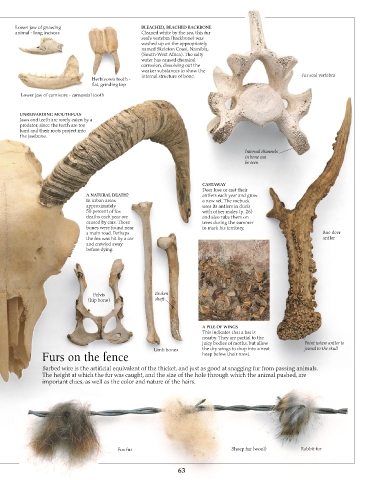
Lower jaw of gnawing                      BLEACHED, BEACHED BACKBONE
      animal - long incisors                    Cleaned white by the sea, this fur
                                                seal’s vertebra (backbone) was
                                                washed up on the appropriately
                                                named Skeleton Coast, Namibia,
                                                (South-West Africa). The salty
                                                water has caused chemical
                                                corrosion, dissolving out the
                                                weaker substances to show the
                                                internal structure of bone.                          Fur seal vertebra
                               Herbivore’s tooth -
                               flat, grinding top
        Lower jaw of carnivore - carnassial tooth


        UNREWARDING MOUTHFULS
        Jaws and teeth are rarely eaten by a
        predator, since the teeth are too
        hard and their roots project into
        the jawbone.

                                                                                  Internal channels
                                                                                  in bone can
                                                                                  be seen


                                                                    CASTAWAY
                                                                    Deer lose or cast their
                              A NATURAL DEATH?                      antlers each year and grow
                              In urban areas                        a new set. The roebuck
                              approximately                         uses its antlers in duels
                              50 percent of fox                     with other males (p. 26)
                              deaths each year are                  and also rubs them on
                              caused by cars. These                 trees during the summer
                              bones were found near                 to mark his territory.
                              a main road. Perhaps                                                          Roe deer
                              the fox was hit by a car                                                      antler
                              and crawled away
                              before dying.


                                Pelvis              Broken
                              (hip bone)            shaft


                                                                    A PILE OF WINGS
                                                                    This indicates that a bat is
                                                                    nearby. They are partial to the
                                                                    juicy bodies of moths, but allow   Point where antler is
                                                    Limb bones      the dry wings to drop into a neat   joined to the skull
               Furs on the fence                                    heap below their roost.
               Barbed wire is the artificial equivalent of the thicket, and just as good at snagging fur from passing animals.
               The height at which the fur was caught, and the size of the hole through which the animal pushed, are
               important clues, as well as the color and nature of the hairs.


                                        Fox fur                               Sheep fur (wool)       Rabbit fur


                                                             3


 (c) 2011 Dorling Kindersley. All Rights Reserved.

