


Page 190 - (DK Eyewitness) Travel Guide - Argentina
P. 190
188 ARGENTINA REGION B Y REGION
7 Jesús María 8 Santa Catalina
Road map C2. 32 miles (51 km) N of See pp190–91.
Córdoba. * 21,000. @ n Jesús
María, Acmafuerte 451, (03525) 443-
773. _ Fiesta Nacional de Doma y
Folklore (Jan).
Founded in the 16th century,
the sleepy market town of Jesús
María was once an impor tant
link in the chain of agricultural
estancias built by the Jesuits to
feed and fund the University
of Córdoba. Most of the town’s
historical buildings date from
the mid-1700s. In 1946 the old
church, convent, bodega, and
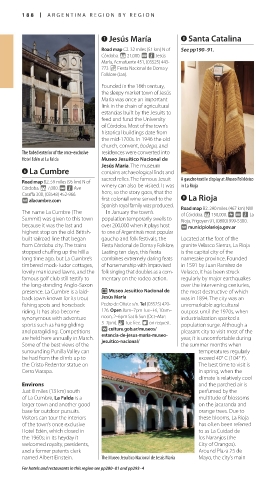
The faded exterior of the once-exclusive residences were converted into
Hotel Edén at La Falda Museo Jesuítico Nacional de
Jesús María. The museum
6 La Cumbre contains archaeological finds and
sacred relics. The famous Jesuit A gaucho textile display at Museo Folklórico
Road map B2. 59 miles (95 km) N of
Córdoba. * 7,000. @ n Ave winery can also be visited. It was in La Rioja
Caraffa 300, (03548) 452-966. here, so the story goes, that the 9 La Rioja
∑ alacumbre.com first colo nial wine served to the
Spanish royal family was produced. Road map B2. 290 miles (467 km) NW
The name La Cumbre (The In January the town’s of Córdoba. * 150,000. ~ @ n La
Summit) was given to this town population temporarily swells to Rioja, Yrigoyen 91, (0800) 999-5300.
because it was the last and over 200,000 when it plays host ∑ municipiolarioja.gov.ar
highest stop on the old British- to one of Argentina’s most popular
built rail road line that began gaucho and folk festivals, the Located at the foot of the
from Córdoba city. The trains Fiesta Nacional de Doma y Folklore. granite Velasco Sierras, La Rioja
stopped chuffing up the hill a Lasting ten days, this fiesta is the capital city of the
long time ago, but La Cumbre’s combines extremely daring feats namesake province. Founded
timbered mock-Tudor cottages, of horse manship with improvised in 1591 by Juan Ramírez de
lovely manicured lawns, and the folk singing that doubles as a com- Velasco, it has been struck
famous golf club still testify to mentary on the rodeo action. regularly by major earthquakes
the long-standing Anglo-Saxon over the intervening centuries,
presence. La Cumbre is a laid- E Museo Jesuítico Nacional de the most destructive of which
back town known for its trout Jesús María was in 1894. The city was an
fishing spots and horseback Pedro de Oñate s/n. Tel (03525) 420- unremarkable agricultural
riding. It has also become 126. Open 8am–7pm Tue–Fri, 10am– outpost until the 1970s, when
synonymous with adventure noon, 2–6pm Sat & Sun (Oct–Mar: industrialization sparked a
sports such as hang gliding 3–7pm). & Tue free. 8 on request. population surge. Although a
∑ cultura.gob.ar/museos/
and paragliding. Competitions pleasant city to visit most of the
are held here annually in March. estancia-de-jesus-maria-museo- year, it is uncomfortable during
jesuitico-nacional/
Some of the best views of the the summer months when
sur rounding Punilla Valley can temperatures regularly
be had from the climb up to exceed 40° C (104° F).
the Cristo Redentor statue on The best time to visit is
Cerro Viarapa. in spring, when the
climate is relatively cool
Environs and the parched air is
Just 8 miles (13 km) south perfumed by the
of La Cumbre, La Falda is a multitude of blossoms
larger town and another good on the jacaranda and
base for outdoor pursuits. orange trees. Due to
Visitors can tour the interiors these blooms, La Rioja
of the town’s once exclusive has often been referred
Hotel Edén, which closed in to as La Cuidad de
the 1960s; in its heyday it los Naranjos (the
welcomed royalty, pres idents, City of Oranges).
and a former patents clerk Around Plaza 25 de
named Albert Einstein. The Museo Jesuítico Nacional de Jesús María Mayo, the city’s main
For hotels and restaurants in this region see pp280–81 and pp293–4
188-189_EW_Argentina.indd 188 05/08/16 10:41 am
Eyewitness Travel LAYERS PRINTED:
Catalogue template “UK” LAYER
(Source v2.6)
Date 12th July 2013
Size 125mm x 217mm

