


Page 192 - (DK Eyewitness) Travel Guide - Argentina
P. 192
190 ARGENTINA REGION B Y REGION
8 Santa Catalina
A UNESCO World Heritage Site, this Jesuit estancia
was founded in 1622. It became an important agri cul
tural and sheep farming estab lish ment, yet its most
important func tion was as the provider of thousands
of mules for cargo trains traveling along the Camino
Real between Buenos Aires and Alto Perú (now Bolivia).
The exten sive site con tained workshops, a smithy, a
carpen try, two flour mills, and a reser voir; there were
also residences for priests, native laborers, and slaves.
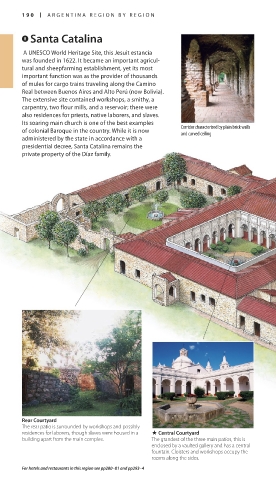
Its soaring main church is one of the best examples Corridor characterized by plain brick walls
of colonial Baroque in the country. While it is now and curved ceiling
administered by the state in accordance with a
presi dential decree, Santa Catalina remains the
private property of the Díaz family.
Rear Courtyard
The rear patio is surrounded by workshops and possibly
residences for laborers, though slaves were housed in a . Central Courtyard
building apart from the main complex. The grandest of the three main patios, this is
enclosed by a vaulted gallery and has a central
fountain. Cloisters and workshops occupy the
rooms along the sides.
For hotels and restaurants in this region see pp280–81 and pp293–4
190-191_EW_Argentina.indd 190 05/08/16 10:41 am
Eyewitness Travel LAYERS PRINTED:
Starsight template “UK” LAYER
(Source v2.7)
Date 24th April 2013
Size 125mm x 217mm

