


Page 191 - (DK Eyewitness) Travel Guide - Argentina
P. 191
C ÓRDOBA AND THE ANDEAN NOR THWEST 189
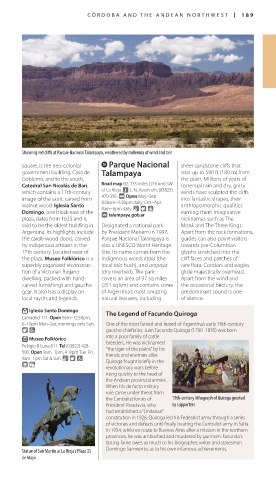
Stunning red cliffs at Parque Nacional Talampaya, weathered by millennia of wind and rain
square, is the neo-colonial 0 Parque Nacional sheer sandstone cliffs that
govern ment building, Casa de Talampaya soar up to 590 ft (180 m) from
Gobierno, and to the south, the plain. Millions of years of
Catedral San Nicolás de Bari, Road map B2. 135 miles (216 km) SW torrential rain and dry, gritty
which con tains a 17th-century of La Rioja. n L. N. Acem s/n, (03825) winds have sculpted the cliffs
470-356. @ Open May−Sep:
image of the saint, carved from 8:30am−5:30pm daily; Oct−Apr: into fantastic shapes, their
walnut wood. Iglesia Santo 8am−6pm daily. & 8 anthro pomorphic qualities
Domingo, one block east of the ∑ talampaya.gob.ar earning them imaginative
plaza, dates from 1623 and is nicknames such as The
said to be the oldest building in Designated a national park Monk and The Three Kings.
Argentina. Its highlights include by President Menem in 1997, Apart from the rock formations,
the carob-wood doors, carved Parque Nacional Talampaya is guides can also point visitors
by indigenous artisans in the also a UNESCO World Heritage towards pre-Columbian
17th century. Located west of Site. Its name comes from the glyphs scratched into the
the plaza, Museo Folklórico is a indigenous words ktala (the cliff faces and patches of
superbly organized recon struc- local tala bush), and ampaya rare flora. Condors and eagles
tion of a Victorian Riojano (dry riverbed). The park glide majestically overhead.
dwelling, packed with hand- covers an area of 97 sq miles Apart from the wind and
carved furnishings and gaucho (251 sq km) and contains some the occasional bird cry, the
gear. It also has a display on of Argentina’s most amazing predominant sound is one
local myths and legends. natural features, including of silence.
R Iglesia Santo Domingo The Legend of Facundo Quiroga
Lamadrid 111. Open 9am–12:30pm,
6–10pm Mon–Sat; mornings only Sun. One of the most famed and feared of Argentina’s early 19th-century
8 7 gaucho chieftains, Juan Facundo Quiroga (1790–1835) was born
into a poor family of cattle
E Museo Folklórico
Pelagio B Luna 811. Tel (03822) 428- breeders. He was nicknamed
“the tiger of the plains” by his
500. Open 9am–1pm, 4–8pm Tue–Fri, friends and enemies alike.
9am–1pm Sat & Sun. & 8 7 Quiroga fought briefly in the
- =
revolutionary wars before
rising quickly to the head of
the Andean provincial armies.
When his de facto military
rule came under threat from
the Centralist forces of 19th-century lithograph of Quiroga greeted
President Rivadavia, who by supporters
had estab lished a “Unitarian”
constitution in 1826, Quiroga led his Federalist army through a series
of victories and defeats until finally beating the Centralist army in Salta.
In 1934, while en route to Buenos Aires after a mission in the northern
provinces, he was ambush ed and murdered by gunmen. Facundo’s
lasting fame owes as much to his biographer, writer and statesman
Statue of San Martín at La Rioja’s Plaza 25 Domingo Sarmiento, as to his own infamous achievements.
de Mayo
188-189_EW_Argentina.indd 189 05/08/16 10:41 am

