


Page 27 - (DK Eyewitness) Travel Guide - Argentina
P. 27
A POR TR AIT OF ARGENTINA 25
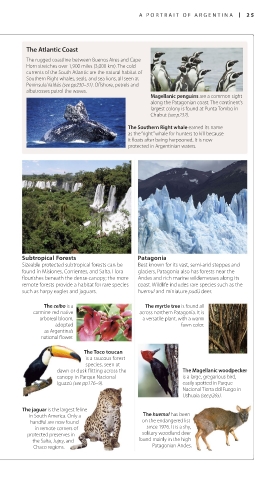
The Atlantic Coast
The rugged coastline between Buenos Aires and Cape
Horn stretches over 1,900 miles (3,000 km). The cold
currents of the South Atlantic are the natural habitat of
Southern Right whales, seals, and sea lions, all seen at
Península Valdés (see pp230–31). Offshore, petrels and
albatrosses patrol the waves.
Magellanic penguins are a common sight
along the Patagonian coast. The continent’s
largest colony is found at Punta Tombo in
Chubut (see p232).
The Southern Right whale earned its name
as the “right” whale for hunters to kill because
it floats after being harpooned. It is now
protected in Argentinian waters.
Subtropical Forests Patagonia
Sizeable protected subtropical forests can be Best known for its vast, semi-arid steppes and
found in Misiones, Corrientes, and Salta. Flora glaciers, Patagonia also has forests near the
flourishes beneath the dense canopy; the more Andes and rich marine wildernesses along its
remote forests provide a habitat for rare species coast. Wildlife includes rare species such as the
such as harpy eagles and jaguars. huemul and miniature pudú deer.
The ceibo is a The myrtle tree is found all
carmine-red native across northern Patagonia. It is
arboreal bloom, a versatile plant, with a warm
adopted fawn color.
as Argentina’s
national flower.
The Toco toucan
is a raucous forest
species, seen at
dawn or dusk flitting across the The Magellanic woodpecker
canopy in Parque Nacional is a large, gregarious bird,
Iguazú (see pp176–9). easily spotted in Parque
Nacional Tierra del Fuego in
Ushuaia (see p265).
The jaguar is the largest feline
in South America. Only a The huemul has been
handful are now found on the endangered list
in remote corners of since 1976. It is a shy,
protected preserves in solitary wood land deer
the Salta, Jujuy, and found mainly in the high
Chaco regions. Patagonian Andes.
024-025_EW_Argentina.indd 25 05/08/16 10:03 am

