


Page 32 - (DK Eyewitness) Travel Guide - Argentina
P. 32
30 INTRODUCING ARGENTINA
Religion in Argentina The Independence movement
in the early 19th cen tury,
Argentina’s most prominent religion is Christianity, with a however, was fron ted by men
large majority of Roman Catholic followers. Native reli gions fired by secu lar passions, and
were unable to resist the combined force of the Spanish the open-door immigration
policy that Argentina adopted
sword and Jesuit teachings, but a certain degree of from the mid-19th century
syncretism took place and a native version of Catholicism onwards created a tolerant,
evolved, replete with saints, super stitions, and native non-denominational society.
iconography. Besides traditional religious practices, The involvement of Catholic
popular cult or folklore figures such as Difunta Correa, church leaders in the 1955
Gauchito Gil, and Ceferino Namuncurá are still venerated military coup and in the
machina tions of the military
throughout the country. govern ment between 1976
and 1983 has cast a pall over
the religious institu tion. There
have been few left-leaning
church leaders in Argentina,
and the country has never
been a seedbed for revolu-
tionary liberation theology,
which focuses on Christ as not
only a Redeemer but also a
Liberator of the oppressed.
The church cannot be said to
have fully met its doc trinal
promise to repre sent the poor.
Consequently, Catholicism is
losing ground to the Mormon
church and to evan gelical
movements in the provinces.
Even the election in 2013 of
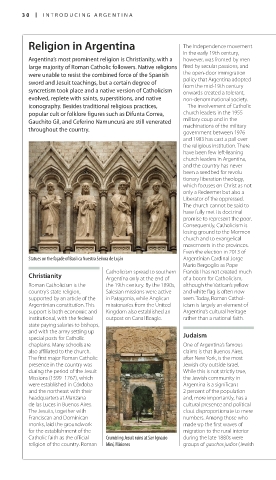
Statues on the façade of Basilica Nuestra Señora de Luján Argentinian Cardinal Jorge
Mario Bergoglio as Pope
Catholicism spread to southern Francis I has not created much
Christianity Argentina only at the end of of a boom for Cath olicism,
Roman Catholicism is the the 19th century. By the 1890s, although the Vatican’s yellow
country’s state religion, Salesian missions were active and white flag is often now
supported by an article of the in Patagonia, while Anglican seen. Today, Roman Cathol-
Argentinian constitution. This missiona ries from the United icism is largely an element of
support is both econo mic and Kingdom also estab lished an Argentina’s cultural heritage
institu tional, with the federal outpost on Canal Beagle. rather than a national faith.
state paying salaries to bishops,
and with the army setting up
special posts for Catholic Judaism
chaplains. Many schools are One of Argentina’s famous
also affilia ted to the church. claims is that Buenos Aires,
The first major Roman Catholic after New York, is the most
presence in the country was Jewish city outside Israel.
during the period of the Jesuit While this is not strictly true,
Missions (1599–1767), which the Jewish community in
were established in Córdoba Argentina is a significant
and the northeast with their 2 percent of the popu lation
headquarters at Manzana and, more impor tantly, has a
de las Luces in Buenos Aires. cultural pre sence and political
The Jesuits, together with clout dispropor tionate to mere
Franciscan and Dominican numbers. Among those who
monks, laid the groundwork made up the first waves of
for the establishment of the migration to the rural interior
Catholic faith as the official Crumbling Jesuit ruins at San Ignacio during the late 1880s were
religion of the country. Roman Miní, Misiones groups of gauchos judios (Jewish
030-031_EW_Argentina.indd 30 05/08/16 10:03 am

