


Page 30 - (DK Eyewitness) Travel Guide - Argentina
P. 30
28 INTRODUCING ARGENTINA
The Gaucho: Symbol and Reality
There are macho cowboy figures throughout the Americas,
but few are as central to the national culture as the gaucho
is to Argentina. The earliest gauchos herded semi-wild
Cimarron cattle in the 17th century, often sleeping out in
the open pampas and riding into town to trade in leather
and tallow. This free-roaming life came to an end when the
vast interior was divided up into huge estancias (ranches)
in the 19th century. Modern-day gauchos still dress in their
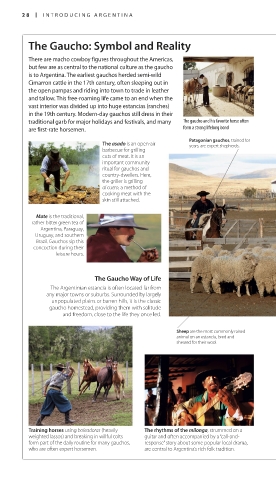
traditional garb for major holidays and festivals, and many The gaucho and his favorite horse often
are first-rate horsemen. form a strong lifelong bond
Patagonian gauchos, trained for
The asado is an open-air years, are expert shepherds.
barbecue for grilling
cuts of meat. It is an
important commu nity
ritual for gauchos and
country-dwellers. Here,
the griller is grilling
al cuero, a method of
cooking meat with the
skin still attached.
Mate is the traditional,
rather bitter green tea of
Argentina, Paraguay,
Uruguay, and southern
Brazil. Gauchos sip this
con coction during their
leisure hours.
The Gaucho Way of Life
The Argentinian estancia is often located far from
any major towns or suburbs. Surrounded by largely
unpopulated plains or barren hills, it is the classic
gaucho homestead, providing them with soli tude
and freedom, close to the life they once led.
Sheep are the most commonly raised
animal on an estancia, bred and
sheared for their wool.
Training horses using boleadoras (heavily The rhythms of the milonga, strummed on a
weighted lassos) and breaking in willful colts guitar and often accompanied by a “call-and-
form part of the daily routine for many gauchos, response” story about some popular local drama,
who are often expert horsemen. are central to Argentina’s rich folk tradition.
028-029_EW_Argentina.indd 28 05/08/16 10:03 am

