


Page 42 - (DK Eyewitness) Travel Guide - Argentina
P. 42
40 INTRODUCING ARGENTINA
Architecture
There is no single architectural style that can be called
Argentinian. Porteño architects have always borrowed from
European styles and the capital is charac terized by eclecticism,
with French mansards, Art Deco cupolas, and glass-walled
skyscrapers. Across the provinces, the most interesting
buildings are often small colonial churches and low-slung
19th- and 20th-century town houses which, with their patios
and wrought-iron gates, pay homage to Andalucia and the
Old World. Occasionally, a Modernist master piece or Brutalist
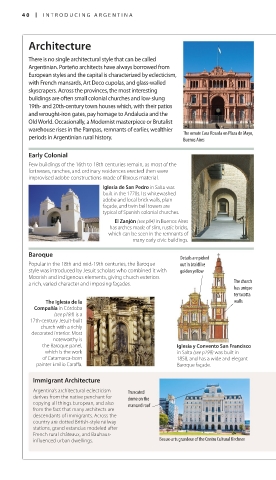
warehouse rises in the Pampas, remnants of earlier, wealthier The ornate Casa Rosada on Plaza de Mayo,
periods in Argentinian rural history. Buenos Aires
Early Colonial
Few buildings of the 16th to 18th centuries remain, as most of the
fortresses, ranches, and ordinary residences erected then were
improvised adobe constructions made of fibrous material.
Iglesia de San Pedro in Salta was
built in the 1770s. Its white washed
adobe and local brick walls, plain
façade, and twin bell towers are
typical of Spanish colonial churches.
El Zanjón (see p84) in Buenos Aires
has arches made of slim, rustic bricks,
which can be seen in the rem nants of
many early civic buildings.
Baroque
Details are picked
Popular in the 18th and mid-19th centuries, the Baroque out in braidlike
style was introduced by Jesuit scholars who combined it with golden yellow
Moorish and indigenous elements, giving church exteriors
a rich, varied character and imposing façades. The church
has unique
terra cotta
The Iglesia de la walls
Compañía in Córdoba
(see p184) is a
17th-century Jesuit-built
church with a richly
deco rated interior. Most
noteworthy is
the Baroque panel, Iglesia y Convento San Francisco
which is the work in Salta (see p199) was built in
of Catamarca-born 1858, and has a wide and elegant
painter Emilio Caraffa. Baroque façade.
Immigrant Architecture
Argentina’s architectural eclecticism Truncated
derives from the native penchant for dome on the
copying all things European, and also mansard roof
from the fact that many architects are
descendants of immigrants. Across the
country are dotted British-style railway
stations, grand estancias modeled after
French rural châteaux, and Bauhaus-
influenced urban dwellings. Beaux-arts grandeur of the Centro Cultural Kirchner
040-041_EW_Argentina.indd 40 07/10/2016 16:54

