


Page 38 - (DK Eyewitness) Travel Guide - Argentina
P. 38
36 INTRODUCING ARGENTINA
Art and Literature Secular Art
in Argentina The War of Independence that
Argentina waged against Spain
It is difficult to identify a cohesive “Argentinian” culture prior had been fueled by the ratio na-
to Independence; neither the descen dants of the Spanish list ideas of the Enlightenment
settlers nor the indi genous tribes regarded them selves as and the French Revolution,
belonging to a “nation” in the modern sense. In the 1700s, so it is no surprise that the
under the Viceroyalty of the Rió de la Plata whose intentions country’s postcolonial artists
largely ignored religious themes.
in the region were purely commercial, Buenos Aires The first major Argentinian
remained a cultural back water. Only gradually, after artists were the painter and
Independence and spurred by immigra tion, a growing lithographer Carlos Morel
middle class, and, later, the explosion of interest in Latin (1813–94) and Prilidiano
American literature, did Argentina and its vibrant capital Pueyrredón (1823–70). The
begin to export as well as to import arts and culture. latter’s Retrato de Manuelita
Rosas and The Bath docu ment
the era with great clarity.
Religious and Cándido López (1840–1902) was
Indigenous Art a painter and soldier famous for
his paintings of the War of the
Pre-Hispanic art in what Triple Alliance (1864–70).
would later become Argentina Buenos Aires pro duced few
was mainly pro duced in the significant artists until the late
country’s northwestern regions, 19th century, when immi gration
particularly in the valleys of invigo rated the city’s cultural
Catamarca and Salta, where scene. Well-known painters
the indige nous population include Benito Quinquela Martín
developed an array of pottery, (1890–1977) and Fortunato
metal work, ceramics, and Lacámera (1887–1951).
textiles. Noteworthy is the Modernist styles, mainly
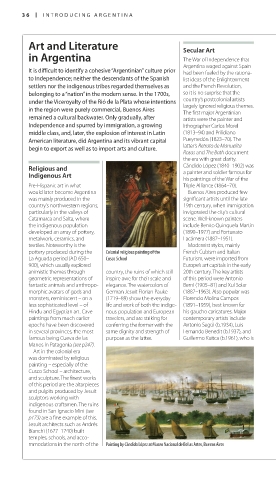
pottery produced during the Colonial religious painting of the French Cubism and Italian
La Aguada period (AD 650– Cusco School Futu rism, were imported from
900), which usually explored Europe’s art capitals in the early
animis tic themes through country, the ruins of which still 20th century. The key artists
geo met ric represent ations of inspire awe for their scale and of this period were Antonio
fantastic animals and anthro po- elegance. The water colors of Berni (1905–81) and Xul Solar
morphic avatars of gods and German Jesuit Florian Pauke (1887–1963). Also popu lar was
monsters, reminiscent – on a (1719–89) show the everyday Florencio Molina Campos
less sophisticated level – of life and work of both the indige- (1891–1959), best known for
Hindu and Egyptian art. Cave nous popu lation and European his gaucho caricatures. Major
painting s from much earlier travelers, and are striking for contem porary artists include
epochs have been discovered conferring the former with the Antonio Segúi (b.1934), Luis
in several prov inces, the most same dignity and strength of Fernando Benedit (b.1937), and
famous being Cueva de las purpose as the latter. Guillermo Kuitca (b.1961), who is
Manos in Patagonia (see p247).
Art in the colonial era
was dominated by reli gious
painting – espe cially of the
Cusco School – archi tecture,
and sculpture. The finest works
of this period are the altarpieces
and pulpits pro duced by Jesuit
sculptors working with
indigenous craftsmen. The ruins
found in San Ignacio Mini (see
p173) are a fine example of this.
Jesuit archi tects such as Andrés
Bianchi (1677–1740) built
temples, schools, and acco-
mmo dations in the north of the Painting by Cándido López at Museo Nacional de Bellas Artes, Buenos Aires
036-037_EW_Argentina.indd 36 05/08/16 10:04 am

