


Page 39 - (DK Eyewitness) Travel Guide - Argentina
P. 39
A POR TR AIT OF ARGENTINA 37
widely exhib ited and is the writing, Argentinian
most lauded Argentinian artist literature has blossomed
of his generation. in the 20th century. Early
talents include Uruguay-
born Horacio Quiroga
Independent Voices: (1878–1937), whose
1810–1880 collections of short fables
Postcolonial Argentina was, made him one of the
for most of the 19th century, precur sors of magical
a divided country where the realism, while Roberto Puig’s El Beso de la Mujer Araña on stage
pens of writers and intellec- Arlt (1900–1942) is
tuals were pitted against the famous for his surreal, a critic and pub lishing the
swords of provincial caudillos vio lent stories of aliena tion and magazine Sur, which provided
in a battle for the support of despair. Manuel Puig (1932–90) a plat form for local writers as
the popu lation. In the view was another influential author well as trans lating European
of writers such as Esteban who used pop art techniques writers for Argentinian readers.
Echeverría (1805–80) and such as montage to startling Protofeminist ideas are evi dent
Domingo Sarmiento (1811–88), effect. His key novels include in the erotically charged
the conflict was between El Beso de la Mujer Araña (1976), writings of poet Alfonsina
European-style civi lization which brought him global fame Storni (1892–1938) and in
(demo cracy and secular ism) after it was made into a movie the anti-patriarchal political
and home-grown and a Broadway works of Latin American
bar barism (dictator- musical. Another playwright and novelist
ship and the law of Argentinian writer Griselda Gambaro (b.1928).
the jungle). whose fame was Other noted contemporary
Echeverría’s and bolstered by a silver- authors include Tomás Eloy
Sarmiento’s bête screen adap tation Martínez (1934–2010), César
noire was the dicta tor was Julio Cortázar Aira (b.1949), and Ricardo Piglia
Juan Manuel de (1914–84): his story (b.1941). No modern writers,
Rosas, whom both Las Babas del Diablo how ever, have come close to
writers attacked in (1959) was the source matching the reputa tion of
their best-known for Michelangelo Jorge Luis Borges (1899–1986),
works, El Matadero Movie poster of Antonioni’s movie the undisputed master of
(1871) and Facundo Blow-up Blow-up (1966). 20th-century Argentinian
(1845) respectively. Julio Cortázar’s letters and one of the most
brilliantly struc tured short influ ential writers to emerge
stories, along with his experi- since World War II. A prolific
Gaucho Literature: mental novels, have made him poet, essayist, and even film
1880–1900 one of the most enduringly critic, Borges is best known for
José Hernández’s (1834–86) popular of all Argentinian his two collections of short
verse epic El Gaucho Martín writers, although he spent most stories, Ficciones and El Aleph.
Fierro (1872) is highly lauded of his life in self-imposed exile, As elusive as they are allusive,
for its free-spirited hero drawn disgusted at the right-wing his bril liant works have
from rural folk ballads. It is and authori ta rian drift of his influenced many major writers
regarded as the greatest homeland. Another politi cally of our time.
expression of the country’s commit ted writer was Rodolfo
national iden tity. Another Walsh (1927–77). Regarded as
key work is Ricardo Güiraldes’s one of the finest and most
(1886–1927) Don Segundo well-known Latin American
Sombra (1926), which casts a jour nalists, he was shot on
skeptical eye on the gaucho the orders of the Argentinian
myth but still paints a vivid military dictator ship in 1977.
portrait of rural life of the era. During the second half of the
20th century, the pro duc tion
and publication of women’s
The Moderns: 1900– writing proliferated in
present day Argentina. Heiress Victoria
Partially on its own merits Ocampo (1890–1979) played a
and also drawn along in the leading role in the intellec tual
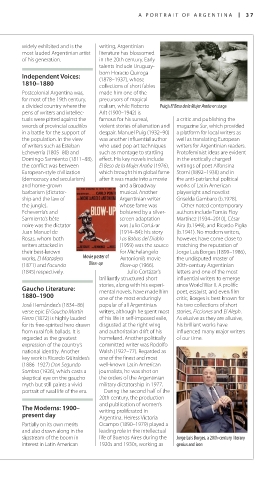
slipstream of the boom in life of Buenos Aires during the Jorge Luis Borges, a 20th-century literary
interest in Latin American 1920s and 1930s, working as genius and icon
036-037_EW_Argentina.indd 37 05/08/16 10:04 am

