


Page 40 - (DK Eyewitness) Travel Guide - Argentina
P. 40
38 INTRODUCING ARGENTINA
Cinema and Theater
A vibrant dramatic arts scene, especially in Buenos Aires,
has existed since the late 1700s, while the Argentinian
cinematic tradition dates back to the late 19th century.
During the 1920s, the capital was one of the major Latin
American centers of film production, a time when theater
also peaked with the sainete criollo (musical comedy).
Although artistic growth was curbed by the military
dictatorship from 1978 to 1983, today over 200 films are
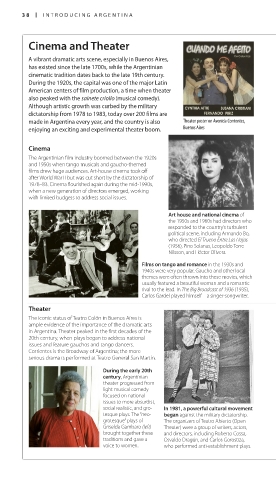
made in Argentina every year, and the country is also Theater poster on Avenida Corrientes,
enjoying an exciting and experimental theater boom. Buenos Aires
Cinema
The Argentinian film industry boomed between the 1920s
and 1950s when tango musicals and gaucho-themed
films drew huge audiences. Art-house cinema took off
after World War II but was cut short by the dictatorship of
1978–83. Cinema flourished again during the mid-1990s,
when a new generation of directors emerged, working
with limited budgets to address social issues.
Art house and national cinema of
the 1950s and 1960s had directors who
respon ded to the country’s turbulent
political scene, including Armando Bo,
who directed El Trueno Entre Las Hojas
(1956), Pino Solanas, Leopoldo Torre
Nilsson, and Héctor Olivera.
Films on tango and romance in the 1930s and
1940s were very popular. Gaucho and other local
themes were often thrown into these movies, which
usually featured a beautiful woman and a romantic
rival to the lead. In The Big Broadcast of 1936 (1935),
Carlos Gardel played himself – a singer-songwriter.
Theater
The iconic status of Teatro Colón in Buenos Aires is
ample evidence of the importance of the dramatic arts
in Argentina. Theater peaked in the first decades of the
20th century, when plays began to add ress national
issues and feature gauchos and tango dancers.
Corrientes is the Broadway of Argentina; the more
serious drama is performed at Teatro General San Martín.
During the early 20th
century, Argentinian
theater pro gressed from
light musi cal comedy
focused on national
issues to more absurdist,
social realistic, and gro- In 1981, a powerful cultural movement
tesque plays. The “neo- began against the military dictatorship.
grotesque” plays of The org ani zers of Teatro Abierto (Open
Griselda Gambaro (left) Theater) were a group of writers, actors,
brought together these and directors, including Roberto Cossa,
traditions and gave a Osvaldo Dragún, and Carlos Gorostiza,
voice to women. who performed anti-establishment plays.
038-039_EW_Argentina.indd 38 05/08/16 10:04 am

