


Page 72 - (DK Eyewitness) Travel Guide - Argentina
P. 72
70 BUENOS AIRES AREA B Y AREA
2 Banco de la
Nación
Ave Rivadavia 325. City Map 3 E5.
Tel (011) 4347-6000. Plaza de
Mayo, Catedral. @ 24, 28, 29, 74, 111,
140, 152. Open 10am–3pm Mon–Fri,
except holidays. 7 Museo Histórico
y Numismático del Banco de la
Nación: Mitre 326. Tel (011) 4347-
6277. Open 10am–3pm Mon–Fri.
7 ^
Once the country’s central
bank, the Banco de la Nación
is a grand example of the
characteristically fortresslike
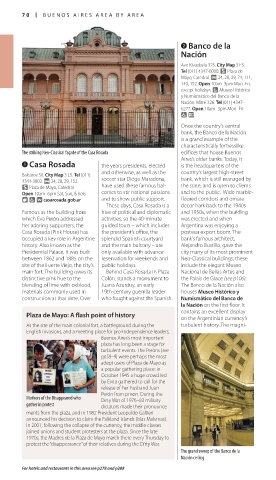
The striking Neo-Classical façade of the Casa Rosada edifices that house Buenos
Aires’s older banks. Today, it
1 Casa Rosada the years presidents, elected is the headquarters of the
and otherwise, as well as the country’s largest high-street
Balcarce 50. City Map 3 E5. Tel (011)
4344-3802. @ 24, 28, 29, 152. soccer star Diego Maradona, bank, which is still managed by
Plaza de Mayo, Catedral. have used these famous bal- the state, and is open to clients
Open 10am–6pm Sat, Sun, & hols. conies to stir national pas sions and to the public. Wide marble-
8 7 ∑ casarosada.gob.ar and to show public support. floored corridors and ornate
These days, Casa Rosada is a decor hark back to the 1940s
Famous as the building from hive of political and diplomatic and 1950s, when the building
which Eva Perón addressed activities, so the 40-minute was erected and when
her adoring supporters, the guided tours – which includes Argentina was enjoying a
Casa Rosada (Pink House) has the president’s office, the postwar export boom. The
occupied a key role in Argentine splendid Spanish courtyard bank’s famous architect,
history. Also known as the and the main balcony – are Alejandro Bustillo, gave the
Presidential Palace, it was built only available with advance city many of its most promi nent
between 1862 and 1885 on the reservation for weekends and Neo -Classical buildings; these
site of the Fuerte Viejo, the city’s public holidays. include the elegant Museo
main fort. The building owes its Behind Casa Rosada in Plaza Nacional de Bellas Artes and
distinctive pink hue to the Colón, stands a monument to the Palais de Glace (see p106).
blending of lime with oxblood, Juana Azurduy, an early The Banco de la Nación also
materials commonly used in 19th-century guerrilla leader houses Museo Histórico y
construction at that time. Over who fought against the Spanish. Numismático del Banco de
la Nación on the first floor. It
contains an excellent display
Plaza de Mayo: A flash point of history on the Argentinian currency’s
As the site of the main colonial fort, a battleground during the turbu lent history. The magni-
English invasions, and a meeting place for pro-Independence leaders,
Buenos Aires’s most important
plaza has long been a stage for
turbulent events. The Peróns (see
pp58–9) were perhaps the most
adept users of Plaza de Mayo as
a popular gathering place: in
October 1945 a huge crowd led
by Evita gathered to call for the
release of her husband Juan
Perón from prison. During the
Mothers of the Disappeared who Dirty War of 1976–83 military
gather in protest dictators made their pronounce-
ments from the plaza, and in 1982 President Leopoldo Galtieri
announced his decision to claim the Falkland Islands (Islas Malvinas).
In 2001, following the collapse of the currency, the middle classes
joined unions and student protesters at the plaza. Since the late
1970s, the Madres de la Plaza de Mayo march there every Thursday to
protest the “disappearance” of their relatives during the Dirty War.
The grand sweep of the Banco de la
Nación ceiling
For hotels and restaurants in this area see p278 and p288
070-071_EW_Argentina.indd 70 05/08/16 10:04 am

