


Page 74 - (DK Eyewitness) Travel Guide - Argentina
P. 74
72 BUENOS AIRES AREA B Y AREA
5 Museo de mass removal to Recoleta 7 Basílica del
la Ciudad following the outbreak of yellow Santisimo Rosario
fever in 1871. One of the rooms
Defensa 219. City Map 3 E5. is an excellent reconstruction of y Convento de
Tel (011) 4343-2123. Plaza de the living quarters of a typical Santo Domingo
Mayo, Catedral. Open 11am–7pm
Mon–Fri, 10am–8pm Sat, Sun, & hols. patrician family of the period. Defensa 422. City Map 1 E1.
& Mon & Wed free. ∑ museo Tel (011) 4331-1668. Bolívar.
delaciudad.buenosaires.gob.ar 6 Museo 8 3–7pm Mon–Fri. 5 12:30pm
Mon–Fri, 6:30pm Sat, 11am Sun.
Located in the heart of the Etnográfico
financial district, the Museo Moreno 350. City Map 3 E5. Work on this church began in
de la Ciudad is on the first floor Tel (011) 4345-8196. Catedral, the mid-18th cen tury, and was
of an elegantly adorned Bolívar, Plaza de Mayo. Open 1–7pm completed 100 years later. It was
pharmaceutical building that Tue–Fri, 3–7pm Sat & Sun. built on land acquired by monks
was part of the Farmacia de la Closed Jan. 8 4pm Sat & Sun. of the Dominican Order in 1601,
Estrella company, created in ∑ museoetnografico.filo.uba.ar soon after their arrival in Buenos
1838 by Swiss immigrant Aires. The area stretched from
Silvestre Demarchi. His sons Founded by the scholar Juan B. Defensa down to the riverfront,
moved it here in the 1890s. Ambrosetti in 1904, this museum present-day Paseo Colón, and
Regarded as one of the most aims to document Argentina’s was at first given over to vege-
impor tant chemists in vast indigenous cul ture. table allot ments, livestock corrals,
South America, it is still It houses ethno graphic and a primitive chapel.
operating, selling a items ranging from The church contains some
stock of tradi tio nal masks and cooking interesting altars and artworks
and homeo pathic imple ments used by from the 17th and 19th cen turies.
medicines on the the Araucana tribes People also come to the site to
ground floor. that lived in the area visit the mauso leum of Manuel
The displays in the before the arrival of Belgrano, designer of the
museum are rotated Europeans, to accounts Argentinian national flag. It is
every few months of Fuegian natives located on the east side near the
and are dedicated to trans planted from their entrance and is marked by an
the everyday life of homes at the “end eternal flame. Post-Independence,
porteños, the people of the world” to East the building was secularized and
who live in Buenos London. Exhibits used as a museum and obser-
Aires. They include Wooden Maori exhibit from include pelts from vatory. It was set ablaze by anti-
aristo cratic hats and New Zealand, Museo Bolivia, feathered clerical Peronists in 1955 and
combs used in the Etnográfico head dresses from later reconse crated in 1967.
19th century and Chaco, and bark
mate gourds still used by all from Brazil. Also on display is
tea-sipping Argentinians. The jewelry and sculpture of the 8 Manzana de
much-prized art of fileteado is Mapuche – the only extant las Luces
also well showcased. The indi genous society in southern Perú 272. City Map 3 E5.
building itself is of interest, as South America. Many Mapuche Tel (011) 4343-3260. Plaza de
it is one of the few remaining were uprooted from their Mayo. 8 3pm Mon–Fri, 3pm,
town houses from the period Andean settlements in the late 4:30pm, & 6pm Sat & Sun.
when wealthy Argentinians 19th century and relocated to ∑ manzanadelasluces.gov.ar
lived in the center – before the province of Buenos Aires. Iglesia de San Ignacio: Tel (011) 4331-
2458. Open 11am–7pm daily. 8
3–6pm Sat & Sun. Colegio Nacional de
Buenos Aires: Tel (011) 4331-0733.
While the nickname “Block of
Enlightenment” was only coined
in the 19th century, learning
and liberty have been the
guiding principles of this con-
stellation of buildings for more
than 400 years. The land was
given to the Jesuits by the
Spanish colonial authorities in
1616, who established a church
and school. After being rigorously
remodeled over the centuries,
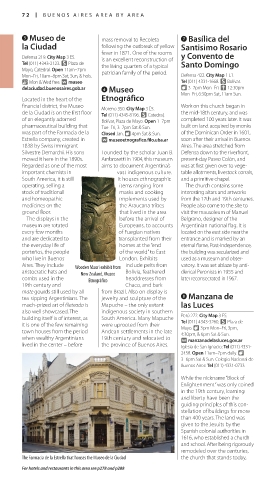
The Farmacia de la Estrella that houses the Museo de la Ciudad the church that stands today,
For hotels and restaurants in this area see p278 and p288
072-073_EW_Argentina.indd 72 05/08/16 10:04 am

