


Page 75 - (DK Eyewitness) Travel Guide - Argentina
P. 75
PLAZA DE M A Y O AND MICROCENTRO 73
Fileteado
Characterized by florid garlands and scrolls of bright colors,
often including the sky-blue and white hues of the national flag,
fileteado is a popular art form that is still seen on display in many
storefront windows. The
compositions sometimes
include texts taken from
local proverbs and sayings.
Banned in the mid-1970s
by the military government,
who preferred straight lines
and right angles –
psychological and
otherwise – it went
underground and is now
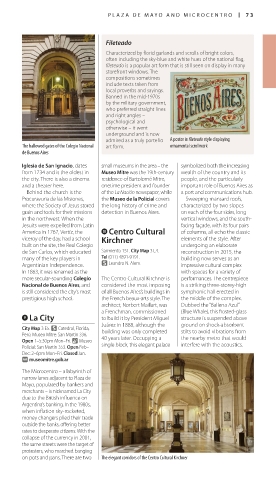
admired as a truly porteño A poster in fileteado style displaying
The hallowed gates of the Colegio Nacional art form. ornamental scrollwork
de Buenos Aires
Iglesia de San Ignacio, dates small museums in the area – the symbolized both the increasing
from 1734 and is the oldest in Museo Mitre was the 19th-century wealth of the country and its
the city. There is also a cinema residence of Bartolomé Mitre, people, and the particularly
and a theater here. onetime president and founder important role of Buenos Aires as
Behind the church is the of the La Nación newspaper, while a port and communications hub.
Procuravuria de las Misiones, the Museo de la Policial covers Sweeping mansard roofs,
where the Society of Jesus stored the long history of crime and characterized by two slopes
grain and tools for their missions detection in Buenos Aires. on each of the four sides, long
in the northwest. When the vertical windows, and the south-
Jesuits were expelled from Latin facing façade, with its four pairs
America in 1767, Vertíz, the 0 Centro Cultural of columns, all echo the classic
viceroy of the day, had a school Kirchner elements of the style. After
built on the site, the Real Colegio undergoing an elaborate
de San Carlos, which educated Sarmiento 151. City Map 3 E4. reconstruction in 2015, the
many of the key players in Tel (011) 4891-9191. building now serves as an
Argentin ian Independence. Leandro N. Alem. impressive cultural complex
In 1863, it was renamed as the with spaces for a variety of
more secular-sounding Colegio The Centro Cultural Kirchner is performances. The centrepiece
Nacional de Buenos Aires, and considered the most imposing is a striking three-storey-high
is still considered the city’s most of all Buenos Aires’s buildings in symphonic hall erected in
prestigious high school. the French beaux-arts style. The the middle of the complex.
architect, Norbert Maillart, was Dubbed the “Ballena Azul”
a French man, commissioned (Blue Whale), this frosted-glass
9 La City to build it by President Miguel structure is suspended above
Juárez in 1888, although the ground on shock-absorbent
City Map 3 E5. Catedral, Florida, building was only completed stilts to avoid vibrations from
Perú. Museo Mitre: San Martín 336.
Open 1–5:30pm Mon–Fri. & Museo 40 years later. Occupying a the nearby metro that would
Policial: San Martín 353. Open Feb– single block, this elegant palace interfere with the acoustics.
Dec: 2–6pm Mon–Fri. Closed Jan.
∑ museomitre.gob.ar
The Microcentro – a labyrinth of
narrow lanes adjac ent to Plaza de
Mayo, populated by bankers and
merchants – is nicknamed La City
due to the British influ ence on
Argentina’s banking. In the 1980s,
when inflation sky-rocketed,
money changers plied their trade
outside the banks, offering better
rates to despe rate citizens. With the
collapse of the currency in 2001,
the same streets were the target of
pro testers, who marched banging
on pots and pans. There are two The elegant corridors of the Centro Cultural Kirchner
072-073_EW_Argentina.indd 73 05/08/16 10:04 am

