


Page 214 - DK Eyewitness Travel Guides - The World's Must-See Places
P. 214
212


                      THAILAND     .A
                WAT A RUN, Q  <= ~
                 BANGKOK     CAMBODIA  I
                                 ~
                                  VIETNAM
                                ·~-
                         GULF  OF
                        THAILAND
            ANOAMAN
              SEA


         THE  C HAKRI  DYNASTY
         In 17?:/., Chao Phraya  C  hakri (later King Ram a I)
         established the C  hakri dynasty in Krung Thep
         (Bangkok). The  reigns of Rama I, II  and Ill were
          a time of stability. Ram a  II was a  literary man,
         while Ram a  Ill was a  staunch traditionalist.
          King Mongkut (Ram a  IV) modernized S iam
          (Thailand), and opened it up to foreign trade
          and influences. His son, King Chulalongkorn,
         or Ran a  V  ([  1868- 1910), was perhaps the
         greatest Chakn Icing. He furthered modern-
         ization by mtrodudng finandal reforms and
         abohsh1ng slavery.  He was  idealized by his
         subjects, and his funeral was a  grand state
         affair. Even today, he is commemorated on
         Chulalongkorn Day (October 23)

         KHMER ARCHITEClURE
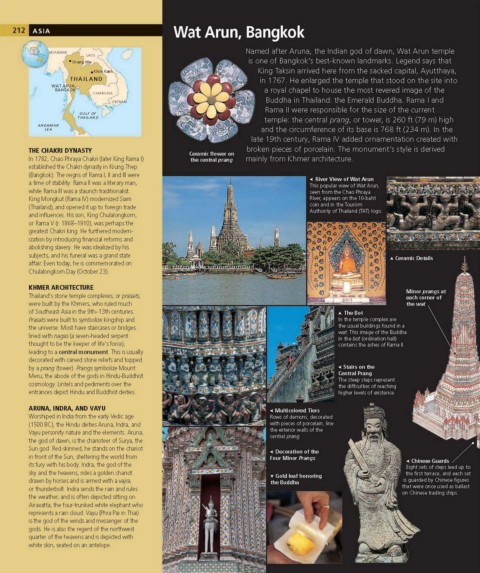
          Thailand's  stone temple complexes, or prasats,
         were bu1it by the Khmers, who ruled much
          of Scotheast Ma in the 9th-13th centunes
         Prasats were built to symbolize kingship and
         the Lrwerse  Most have staircases or bridges
         lined With nagas (a seven-headed serpent
         thought to be the keeper of life's force),
         leading to a  central monument This  is us ually
         decorated with carved stone rei iefs  and topped
         by a  prang (tower)  Prangs symbolize  Mount
          lVI eru, the abode of the gods in Hindu-Buddhist
          cosmology.  Lintels and pediments over the
          entrances depict Hindu and Buddhist deities


         ARUNA,  INDRA, AND VAYU
         Worstvped 1n India from the early Vedic age
         (  1500 BC), the HmciJ deities Aruna, lndra, and
         Vayu person1fy nature and the elements.  Aruna,
         the god of dawn, is the charioteer of Surya, the
         S un god. Red-skinned, he stands on the chariot
         in front of the Sun, sheltering the world from
         its  fury with his body. lndra, the god of the
          sky and the heavens, rides a  golden chariot
          drawn by horses and is armed with a  vajra,
          or thunderbolt lndra sends the rain and nules
         the weather, and is often depicted sitting on
         Air  avatta, the fcor-tnunked white elephant who
         represents a  ran doud. Vayu (Phra Pai 1n Thai)
         IS the god of the winds and messenger of the
         gods. He is  also the regent of the northwest
         quarter of the heavens and is depicted with
         white  skin, seated on an antelope.

