


Page 41 - DK Eyewitness Travel Guides - The World's Must-See Places
P. 41
GREAT  BRITAIN  39


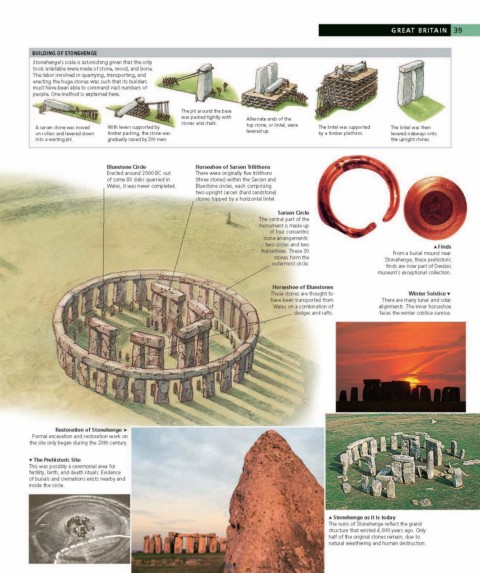
          BUILDING OF STONEHENGE
           Stonehenge's scale is astonishing given that the only
           tools available were made of stone, wood, and bone.
           The labor involved in quarrying, transporting, and
           erecting the huge stones was such that its builders
           must have been able to <Ommand vast numbers of
           people. One method is explained here.
          ~                                            was packed tightly with   Alternate ends of the
                                                       The pit around the base

           A sarsen stone was moved   With levers supported by   stones and chalk.   top stone, or lintel, were   The lintel was supported   The lintel was then
           on rollers and levered down   timber packing, the stone was    levered up.           by a timber platform.   levered sideways onto
           into a waiting pit.   gradually raised by 200 men.                                                         the upright stones.


                                 Bluestone Cir<le          Horseshoe of Sarsen Trilithons
                                 Erected around 2000 BC  out   There were originally five  trilithons
                                 of some 80 slabs quarried in   (three stones) within the Sarcen and
                                 Wales, it was never completed.   Bluestone dr<les, each  comprising
                                                           two upright sarcen  (hard sandstone)
                                                           stones topped by a horizontal lintel.

                                                                                    Sarsen Circle
                                                                              The central part of the
                                                                              monument is made up
                                                                                 of four concentric
                                                                               stone arr ang emen ts:
                                                                                two d'rcles and two
                                                                                                                                  A Finds
                                                                               horseshoes. These 30                   From a burial mound near
                                                                                   stones form the                  Stonehenge, these prehistoric
                                                                                  outermost circle.                 finds are now part of Devizes
                                                                    /  ""-""''""~"~                               museum's exceptional collection.


                                                                                  These stones are thought to
                                                                                                                           Winter Solstice Y
                                                                                  have been transported from       There are many lunar and solar
                                                                                  Wales on a combination of       alignments. The inner horseshoe
                                                                                         sledges and rafts.       faces the winter solstice sunrise.


                 Restoration of Stonehenge >
          Formal excavation and restoration work on
          the site only began during the 20th century.

         Y The Prehistoric Site
          This was possibly a ceremonial area  for
          fertility, birth, and death rituals. Evidence
          of burials and cremations exists nearby and
          inside the circle.


                                                                                                   A Stonehenge as it is today
                                                                                                   The ruins of Stonehenge reflect the grand
                                                                                                   structure that existed 4,000 years ago. Only
                                                                                                   half of the original stones remain, due to
                                                                                                   natural weathering and human destruction.

