


Page 218 - (DK Eyewitness) Travel Guide - Australia
P. 218
216 queensland
The Great Barrier Reef
Coral reefs are among the oldest and most primitive forms
of life, dating back at least 500 million years. Today, the Great
Barrier Reef is the largest reef system in the world, covering
2,000 km (1,250 miles) from Bundaberg to the tip of Cape York
and an area of approximately 350,000 sq km (135,000 sq miles).
Between the outer edges of the reef and the mainland, there
are more than 2,000 islands and almost 3,000 separate reefs, Locator Map
of differing types. On islands with a fringing reef, coral can
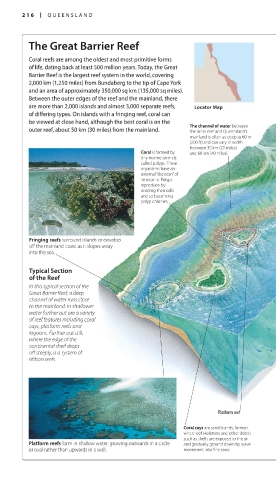
be viewed at close hand, although the best coral is on the The channel of water between
outer reef, about 50 km (30 miles) from the mainland. the inner reef and Queensland’s
mainland is often as deep as 60 m
(200 ft) and can vary in width
between 30 km (20 miles)
Coral is formed by and 60 km (40 miles).
tiny marine animals
called polyps. These
organisms have an
external “skeleton” of
limestone. Polyps
reproduce by
dividing their cells
and so becoming
polyp colonies.
Fringing reefs surround islands or develop
off the mainland coast as it slopes away
into the sea.
Typical Section
of the Reef
In this typical section of the
Great Barrier Reef, a deep
channel of water runs close
to the mainland. In shallower
water further out are a variety
of reef features including coral
cays, platform reefs and
lagoons. Further out still,
where the edge of the
continental shelf drops
off steeply, is a system of
ribbon reefs.
Platform reef
Coral cays are sand islands, formed
when reef skeletons and other debris
such as shells are exposed to the air
Platform reefs form in shallow water, growing outwards in a circle and gradually ground down by wave
or oval rather than upwards in a wall. movement into fine sand.

