


Page 219 - (DK Eyewitness) Travel Guide - Australia
P. 219
Introduc I ng queensland 217
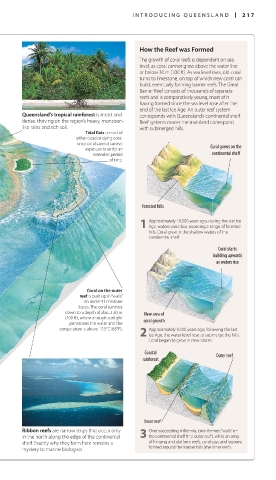
How the Reef was Formed
The growth of coral reefs is dependent on sea
level, as coral cannot grow above the water line
or below 30 m (100 ft). As sea level rises, old coral
turns to limestone, on top of which new coral can
build, eventually forming barrier reefs. The Great
Barrier Reef consists of thousands of separate
reefs and is comparatively young, most of it
having formed since the sea level rose after the
end of the last Ice Age. An outer reef system
Queensland’s tropical rainforest is moist and corresponds with Queensland’s continental shelf.
dense, thriving on the region’s heavy, monsoon- Reef systems nearer the mainland correspond
like rains and rich soil. with submerged hills.
Tidal flats consist of
either dead or dying coral,
since coral cannot survive
exposure to air for an Coral grows on the
extended period continental shelf
of time.
Forested hills
Approximately 18,000 years ago, during the last Ice
1 Age, waters were low, exposing a range of forested
hills. Coral grew in the shallow waters of the
continental shelf.
Coral starts
building upwards
as waters rise
Coral on the outer
r r reef is built up in “walls” eef is built up in “walls” eef
on ancient limestone
bases. The coral survives
down to a depth of about 30 m New area of
(100 ft), where enough sunlight
penetrates the water and the coral growth
temperature is above 17.5°C (65°F). Approximately 9,000 years ago, following the last
2 Ice Age, the water level rose to submerge the hills.
Coral began to grow in new places.
Coastal
rainforest Outer reef
Inner reef
Ribbon reefs are narrow strips that occur only Over succeeding millennia, coral formed “walls” on
in the north along the edge of the continental 3 the continental shelf (the outer reef), while an array
shelf. Exactly why they form here remains a of fringing and platform reefs, coral cays and lagoons
mystery to marine biologists. formed around the former hills (the inner reef).

