


Page 221 - (DK Eyewitness) Travel Guide - Australia
P. 221
INTRODUCING QUEENSLAND 219
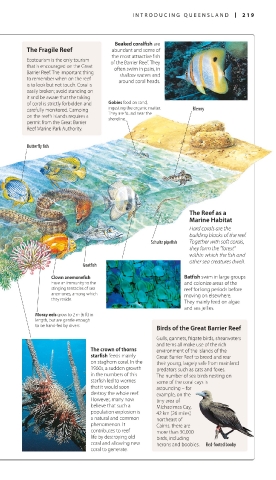
Beaked coralfish are
The Fragile Reef abundant and some of
the most attractive fish
Ecotourism is the only tourism of the Barrier Reef. They
that is encouraged on the Great often swim in pairs, in
Barrier Reef. The important thing shallow waters and
to remember when on the reef around coral heads.
is to look but not touch. Coral is
easily broken; avoid standing on
it and be aware that the taking
of coral is strictly forbidden and Gobies feed on sand,
carefully monitored. Camping ingesting the organic matter. Blenny
They are found near the
on the reef’s islands requires a shoreline.
permit from the Great Barrier
Reef Marine Park Authority.
Butterfly fish
The Reef as a
Marine Habitat
Hard corals are the
building blocks of the reef.
Schultz pipefish Together with soft corals,
they form the “forest”
within which the fish and
other sea creatures dwell.
Goatfish
Clown anemonefish Batfish swim in large groups
have an immunity to the and colonize areas of the
stinging tentacles of sea reef for long periods before
anemones, among which moving on elsewhere.
they reside.
They mainly feed on algae
and sea jellies.
Moray eels grow to 2 m (6 ft) in
length, but are gentle enough
to be hand-fed by divers.
Birds of the Great Barrier Reef
Gulls, gannets, frigate birds, shearwaters
and terns all make use of the rich
The crown of thorns environment of the islands of the
starfish feeds mainly Great Barrier Reef to breed and rear
on staghorn coral. In the their young, largely safe from mainland
1960s, a sudden growth predators such as cats and foxes.
in the numbers of this The number of sea birds nesting on
starfish led to worries some of the coral cays is
that it would soon astounding – for
destroy the whole reef. example, on the
However, many now tiny area of
believe that such a Michaelmas Cay,
population explosion is 42 km (26 miles)
a natural and common northeast of
phenomenon. It Cairns, there are
contributes to reef more than 30,000
life by destroying old birds, including
coral and allowing new herons and boobies. Red-footed booby
coral to generate.

