


Page 220 - (DK Eyewitness) Travel Guide - Australia
P. 220
218 QUEENSLAND
Life on the Great Barrier Reef
More than 2,000 species of fish and innumerable species of
hard and soft coral are found in the waters of the Great
Barrier Reef. The diversity of life forms is extraordinary, such
as echinoderms (including sea urchins), crustaceans and
sponges. There is also an array of invertebrates, such as the
graceful sea slug, some 12 species of sea grasses and 500
types of algae. The reef islands and coral cays support a
wonderfully colourful variety of tropical birdlife. This
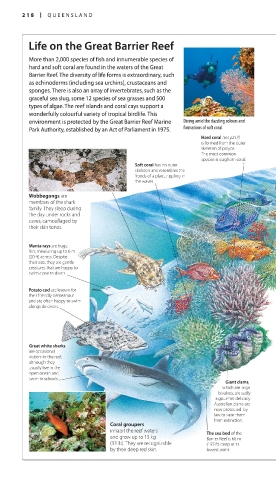
environment is protected by the Great Barrier Reef Marine Diving amid the dazzling colours and
Park Authority, established by an Act of Parliament in 1975. formations of soft coral.
Hard coral (see p217)
is formed from the outer
skeleton of polyps.
The most common
species is staghorn coral.
Soft coral has no outer
skeleton and resembles the
fronds of a plant, rippling in
the waves.
Wobbegongs are
members of the shark
family. They sleep during
the day under rocks and
caves, camouflaged by
their skin tones.
Manta rays are huge
fish, measuring up to 6 m
(20 ft) across. Despite
their size, they are gentle
creatures that are happy to
swim close to divers.
Potato cod are known for
their friendly demeanour
and are often happy to swim
alongside divers.
Great white sharks
are occasional
visitors to the reef,
although they
usually live in the
open ocean and
swim in schools.
Giant clams,
which are large
bivalves, are sadly
a gourmet delicacy.
Australian clams are
now protected by
law to save them
from extinction.
Coral groupers
inhabit the reef waters The sea bed of the
and grow up to 15 kg Barrier Reef is 60 m
(33 lb). They are recognizable (195 ft) deep at its
by their deep red skin. lowest point.

