


Page 13 - Encyclopedia of Aquarium and Pond Fish, 3rd Edition
P. 13
HOW TO USE THIS BOOK 11
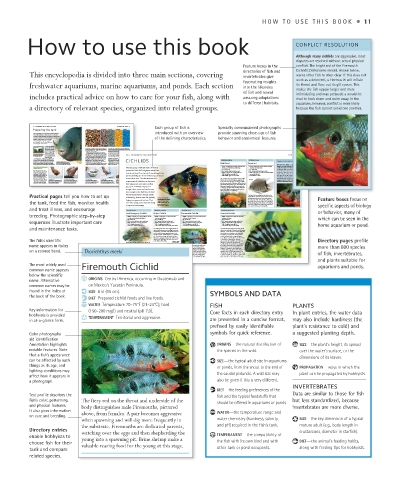
How to use this book CONFLICT RESOLUTION
Although many cichlids are aggressive, most
disputes are resolved without actual physical
Feature boxes in the conflict. The bright red of the Firemouth
This encyclopedia is divided into three main sections, covering directories of fish and Cichlid (Cichlasoma meeki), shown below,
warns other fish to steer clear. If this does not
invertebrates give
freshwater aquariums, marine aquariums, and ponds. Each section fascinating insights work as a deterrent, a Firemouth will inflate
its throat and flare out its gill covers. This
into the lifestyles
makes the fish appear larger and more
includes practical advice on how to care for your fish, along with of fish and reveal intimidating and may persuade a would-be
amazing adaptations
rival to back down and swim away. In the
to different habitats. aquarium, however, conflict is more likely
a directory of relevant species, organized into related groups. because the fish cannot avoid one another.
38 FRESHWATER FISH: SETTING UP THE TANK PREPARING THE TANK 39 Each group of fish is Specially commissioned photographs
Preparing the tank COARSE GRAVEL PEA GRAVEL FINE-GRAINED GRIT GLASS BEADS YELLOW GRAVEL BLUE GRAVEL
A little forethought goes a long way when setting up an aquarium. introduced with an overview provide stunning close-ups of fish
Give careful consideration to where you want to site the tank,
because if you make a poor choice, you will have to empty the tank
and strip it down before it can be moved elsewhere. It is also a of the defining characteristics. behavior and anatomical features.
good idea to plan the layout of the tank well in
advance so that you end up with an aquarium
that not only looks attractive but also allows the
fish to display their natural behavior.
One of the most important
elements in the aquarium
will be the substrate—the is appropriate for the fish you intend to keep. The large stones Pea gravel, the most commonly used type, has a grain size of 1 ⁄8 in (3–4 mm);
material covering the floor of coarse-grained gravel, for example, will not be suitable for anything finer may reduce the efficiency of the undergravel filter. Coarser gravel
tends to trap uneaten food in the gaps between the stones. Glass beads and
of the tank. This not only fish that habitually dig in the substrate, bury themselves in it, dyed gravel provide attractive alternatives, but choose dyed gravel carefully,
forms an essential part of the or sift the stones in search of food. because strong colors may detract from the appearance of the fish.
habitat for the fish but also When buying gravel, bear in mind that a layer of about
Visualize the finished tank. Knowing provides anchorage for the 2 in (5 cm) is needed to create the filter bed, so allow roughly this will dissolve slowly and increase the water’s hardness. You
how you want your tank to look will roots of aquarium plants and 2 lb (1 kg) of gravel for every gallon (4 liters) of tank capacity. can test gravel by adding vinegar to a small sample. If it contains CICHLIDS 137
136 FRESHWATER FISH DIRECTORY
make it much easier and quicker to a surface on which beneficial Although aquarium gravel is usually prewashed, this does not limestone, the vinegar will fizz as it reacts with the calcium.
assemble the different elements. bacteria can develop. mean that it is necessarily clean enough for the tank. Rinse it
For fish that require a sandy substrate, use filtration sand thoroughly to remove all traces of sediment; otherwise, you Rockwork and bogwood
or river sand, which are chemically inert (they do not affect may find that a muddy scum forms on the water when you With the gravel bed in place, you can begin to furnish the
the water) and non-compacting. However, most freshwater fill the aquarium. It is also advisable to soak the gravel tank. Rockwork not only looks attractive but also provides CICHLIDS Amphilophus labiatus Cichlasoma severum
aquariums use gravel as the substrate, since the water passes Use gravel with rounded stones for overnight in aquarium disinfectant, to reduce the likelihood egg-laying sites for a number of tropical species—especially CONFLICT RESOLUTION
through it more easily than sand, making the undergravel bottom dwellers, substrate feeders, and fish that of introducing disease or parasites into the tank. cichlids, which favor slate. In addition, rockwork offers fish
filter (see p.34) more effective. Aquarium gravel is available as this Black Belt Cichlid (see p.138). Avoid rough or If you intend to keep fish that require soft-water conditions, places to shelter, and more aggressive species may use it to Red Devil Severum
excavate the substrate for breeding purposes, such
in various grain sizes, but make sure that the gravel you choose sharp-edged gravel, which may cut or scratch the fish. avoid gravel containing limestone (calcium carbonate), since mark out their territories. Although many cichlids are aggressive, most
disputes are resolved without actual physical
This large group of fish (the name of which is ORIGINS Central America, restricted to Lake Xiloa, Lake ORIGINS Northern parts of South America, extending conflict. The bright red of the Firemouth
SIZE 10 in (25 cm).
SIZE 8 in (20 cm).
PREPARATORY TASKS Nicaragua, and Lake Managua in Nicaragua. throughout the Amazon basin. Cichlid (Thorichthys meeki), shown below,
Before adding components such as decor, pronounced “sick-lids”) originates mainly from
equipment, and plants, you will need to wash DIET Prepared cichlid foods and live foods. DIET Prepared cichlid foods and live foods. warns other fish to steer clear. If this does
the tank and the substrate with clean, warm WATER Temperature 75–79°F (24–26°C); hard WATER Temperature 73–77°F (23–25°C); soft (50 mg/l) not work as a deterrent, a Firemouth will
water (do not use detergent) and install the Central and South America and Africa, although three (100–150 mg/l) and neutral (pH 7.0). and acidic (pH 6.0–6.5). inflate its throat and flare out its gill covers.
undergravel filter. Handling a wet glass tank
can be hazardous, so allow the outside of the species (including one recent rediscovery) are known TEMPERAMENT Aggressive and territorial. TEMPERAMENT Territorial. This makes the fish appear larger and more
tank to dry before placing it on its stand, intimidating and may persuade a would-be
which must be level and stable. As a general
hygiene rule, keep equipment used for 1 Wash the tank 2 Position on sponge matting 3 3 Clean the gravel 4 4 Place the filter 5 Slope the gravel to come from Asia. The characteristics and Like a number of other Central American cichlid rival to back down and swim away. In the
2
1
5
aquarium tasks, such as sponges and buckets, Add a little water to the tank and wipe the Glass tanks should stand on specially made After soaking the gravel in aquarium Lay an undergravel filter directly on the Smooth out the gravel by hand, sloping it species, the Red Devil is relatively adaptable in Juvenile aquarium, however, conflict is more likely
separate from items used for domestic chores. glass with a clean sponge. This will remove sponge matting, to absorb any unevenness in disinfectant, pour it into a colander and aquarium floor. Place the airlift at the back, or upward to the back of the tank. This will requirements of cichlids are as diverse as terms of its water chemistry needs. It is reddish, because the fish cannot avoid one another.
If possible, pour dirty water down outside dust or tiny fragments of glass left over the surface below, which could cause the rinse it under a running faucet, stirring the else a power filter can be put in place later, make it easier to spot any buildup of mulm
drains, not into a kitchen or bathroom sink. from the manufacturing process. joints between the glass panels to leak. gravel occasionally with your hand. with the gravel carefully tipped in beforehand. (decayed organic matter) at the front. but the precise depth of coloration differs between
their origins, and most make excellent individuals. The female of a pair, discernible by her
pets. Some individuals may learn to blunt genital papilla and smaller size, may lay up
to 700 eggs, guarding them until they hatch after
recognize their owner and even become about three days. It may take a further week for
the fry to become free-swimming.
tame enough to take food from the hand.
Practical pages tell you how to set up The breeding behavior of many cichlids The Ram or Butterfly The black band extending from the dorsal to the Feature boxes focus on
ventral fin is a key feature of the Severum. Young
is fascinating, because these fish typically
individuals show a series of such bands running
Cichlid (Mikrogeophagus
down the sides of the body, but these fade as they
the tank, feed the fish, monitor health display strong parental instincts. Their ramirezi) is one of the grow older. Once mature, males can be identified
care of the young can be observed closely
by the elongated tips on the dorsal and ventral fins,
smaller members of the
group, growing to less
in aquarium surroundings. than 3 in (7.5 cm) long. and by the reddish-brown patterning on the head. specific aspects of biology
Pairs may not always prove compatible.
and treat illness, and encourage Rocio octofasciata Amphilophus citrinellus Thorichthys meeki Amatitlania nigrofasciata or behavior, many of
breeding. Photographic step-by-step Jack Dempsey Cichlid Midas Cichlid Firemouth Cichlid Convict Cichlid
ORIGINS Central America, occurring in Costa Rica,
ORIGINS Central America, ranging from Guatemala
ORIGINS Central America, occurring on Mexico’s Yucatán
ORIGINS Central America, occurring in Guatemala and
Peninsula and in Guatemala and Honduras. Nicaragua, and Honduras. on Mexico’s Yucatán Peninsula. southward to Panama. which can be seen in the
SIZE 8 in (20 cm).
SIZE 6 in (15 cm).
SIZE 6 in (15 cm).
SIZE 12 in (30 cm).
sequences illustrate important care DIET Prepared cichlid foods, algae, and live foods. DIET Prepared cichlid foods and live foods. DIET Prepared cichlid foods and live foods. DIET Prepared cichlid foods, algae, and live foods.
WATER Temperature 72–77°F (22–25°C); hard
WATER Temperature 68–77°F (20–25°C); hard
WATER Temperature 70–77°F (21–25°C); hard
WATER Temperature 70–75°F (21–24°C); hard
(100–150 mg/l) and neutral (pH 7.0). (100–150 mg/l) and neutral (pH 7.0). (150–200 mg/l) and neutral (pH 7.0). (100–150 mg/l) and neutral (pH 7.0). home aquarium or pond.
TEMPERAMENT Intolerant and aggressive. TEMPERAMENT Aggressive, destructive, and territorial. TEMPERAMENT Territorial and aggressive. TEMPERAMENT Aggressive and territorial.
and maintenance tasks. The Midas gets its name from its gold coloration. The black and bluish stripes on the body of this
fish are not dissimilar to the pattern of old prison
Males develop a pronounced swelling, known as a
nuchal hump, on the head. Pairs should be housed uniforms—hence the name Convict Cichlid. The
on their own in a large, sparsely decorated tank. female lacks the extensions to the dorsal and
Include rockwork, which will serve as a spawning ventral fins seen in the male, but she is more
site. Partial water changes will mimic the rains colorful, with yellowish-orange underparts.
A rare albino variant has also been bred. Provide
that trigger spawning activity in the wild. Females
The fish’s scientific Named after the late American boxer because of will lay up to 1,000 eggs. The fry feed on mucus a relatively bare aquarium for spawning Directory pages profile
on the flanks of the adults.
purposes, but add a clay flowerpot and some
Young are duller
slate to give a choice of egg-laying sites.
in color than
name appears in italics its pugnacious nature, the Jack Dempsey Cichlid adults The fiery red on the throat and underside of the As with related species, bloodworm and other more than 800 species
live foods are important to keep these fish in
displays a series of variable turquoise and yellowish
good condition. Convict Cichlids also feed
body distinguishes male Firemouths, pictured
markings over its body. Sexing can be done on the
basis of the fins: in males, the anal and dorsal fins above, from females. A pair becomes aggressive readily on vegetation, so they should only
on a colored band. Thorichthys meeki have pointed tips, with the latter displaying red when spawning, and will dig more frequently in be housed with tough plants, which they are
the substrate. Firemouths are dedicated parents,
unlikely to destroy. Pairs will usually care for
edging, too. Pairs look after their young together,
watching over the eggs and then shepherding the
corralling them at first in special spawning pits
excavated in the substrate. The eggs, numbering young into a spawning pit. Brine shrimp make a their young, but should they ignore them, it may of fish, invertebrates,
be better to transfer the brood to a separate tank
as many as 800, are laid on cleaned rockwork. Juvenile valuable rearing food for the young at this stage. where they can be reared safely on their own.
and plants suitable for
The most widely used Firemouth Cichlid aquariums and ponds.
common name appears
below the scientific
name. Alternative ORIGINS Central America, occurring in Guatemala and
common names may be on Mexico’s Yucatán Peninsula.
found in the index at SIZE 6 in (15 cm).
the back of the book. DIET Prepared cichlid foods and live foods. SYMBOLS AND DATA
WATER Temperature 70–75°F (21–24°C); hard FISH PLANTS
Key information for (150–200 mg/l) and neutral (pH 7.0).
hobbyists is provided TEMPERAMENT Territorial and aggressive. Core facts in each directory entry In plant entries, the water data
in at-a-glance form. are presented in a concise format, may also include hardiness (the
prefixed by easily identifiable plant’s resistance to cold) and
Color photographs symbols for quick reference. a suggested planting depth.
aid identification.
Annotation highlights ORIGINS—the natural distribution of SIZE—the plant’s height, its spread
notable features. Note the species in the wild. over the water’s surface, or the
that a fish’s appearance dimensions of its leaves.
can be affected by such SIZE—the typical adult size in aquariums
things as its age, and or ponds, from the snout to the end of PROPAGATION—ways in which the
lighting conditions may
affect how it appears in the caudal peduncle. A wild size may plant can be propagated by hobbyists.
a photograph. also be given if this is very different.
INVERTEBRATES
DIET—the feeding preferences of the
Text profile describes the fish and the typical foodstuffs that Data are similar to those for fish
fish’s color, patterning, The fiery red on the throat and underside of the should be offered in aquariums or ponds. but less standardized, because
and physical features. body distinguishes male Firemouths, pictured invertebrates are more diverse.
It also gives information WATER—the temperature range and
on care and breeding. above, from females. A pair becomes aggressive
when spawning and will dig more frequently in water chemistry (hardness, salinity, SIZE—the key dimension of a typical
the substrate. Firemouths are dedicated parents, and pH) required in the fish’s tank. mature adult (e.g., body length in
Directory entries watching over the eggs and then shepherding the crustaceans, diameter in starfish).
enable hobbyists to young into a spawning pit. Brine shrimp make a TEMPERAMENT—the compatibility of
choose fish for their valuable rearing food for the young at this stage. the fish with its own kind and with DIET—the animal’s feeding habits,
tank and compare other tank or pond occupants. along with feeding tips for hobbyists.
related species.
US_010-011_Preface_How_to_use.indd 11 29/08/18 4:08 PM

