


Page 16 - Encyclopedia of Aquarium and Pond Fish, 3rd Edition
P. 16
14    INTRODUCTION TO FISHKEEPING

         Diversity
                                                             Africa
                                                            Lake Malawi
         Fish have colonized almost every aquatic environment
         on the planet. Blackfin Icefish inhabit the freezing depths   South
         of the Antarctic Ocean, while Desert Pupfish thrive at   Atlantic
                                                           Ocean
         over 104°F (40°C) in pools in the Nevada Desert.
         The huge diversity of fish habitats worldwide has driven
         the evolution of the countless shapes, sizes, and colors
         that make fish so fascinating to keep.


         The observed diversity in the appearance of fish is the
         product of millions of years of evolution. Imperceptibly, the
         forces of natural selection have shaped every fish’s external
         form, internal anatomy, and behavior to deal with the
         challenges of its own very particular environment; in the
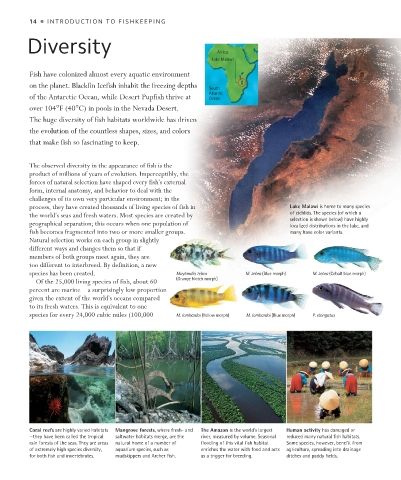
         process, they have created thousands of living species of fish in       Lake Malawi is home to many species
         the world’s seas and fresh waters. Most species are created by          of cichlids. The species (of which a
         geographical separation; this occurs when one population of             selection is shown below) have highly
                                                                                 localized distributions in the lake, and
         fish becomes fragmented into two or more smaller groups.                many have color variants.
         Natural selection works on each group in slightly
         different ways and changes them so that if
         members of both groups meet again, they are
         too different to interbreed. By definition, a new
         species has been created.                Maylandia zebra    M. zebra (Blue morph)  M. zebra (Cobalt blue morph)
           Of the 25,000 living species of fish, about 60   (Orange blotch morph)
         percent are marine—a surprisingly low proportion
         given the extent of the world’s oceans compared
         to its fresh waters. This is equivalent to one
         species for every 24,000 cubic miles (100,000   M. lombardoi (Yellow morph)  M. lombardoi (Blue morph)  P. elongatus


         Coral reefs are highly varied habitats   Mangrove forests, where fresh- and   The Amazon is the world’s largest   Human activity has damaged or
         —they have been called the tropical   saltwater habitats merge, are the   river, measured by volume. Seasonal   reduced many natural fish habitats.
         rain forests of the seas. They are areas    natural home of a number of   flooding of this vital fish habitat   Some species, however, benefit from
         of extremely high species diversity,    aquarium species, such as    enriches the water with food and acts   agriculture, spreading into drainage
         for both fish and invertebrates.  mudskippers and Archer Fish.  as a trigger for breeding.  ditches and paddy fields.


   US_014-015_Diversity.indd   14                                                                    29/08/18   4:08 PM

