


Page 17 - Encyclopedia of Aquarium and Pond Fish, 3rd Edition
P. 17
DIVERSITY    15

                                                 1
           3
         km ) of sea water, compared to one species for every 3 ⁄2 cubic   New species are constantly being discovered.
         miles (15 km ) of fresh water. The diversity of freshwater   The Red Dwarf Pencilfish (Nannostomus
                   3
         fish relative to the size of their habitat is due to the ease with   mortenthaleri) was first collected as recently
                                                          as 2000 from the Rio Nanay near the town
         which groups of fish can become separated and geographically   of Albarenga, Peru.
         isolated in rivers and pools, compared with the sea.
         Geography and species formation
         There is no better example of diversification and species
         formation than Lake Malawi in Africa’s Great Rift Valley.
         Created about two million years ago by a geological fault, the
         365-mile- (584-km-) long lake is today home to more than 1,600
         species of cichlids—more than occur in all of the rest of
         Africa. It is thought that all these cichlids developed from just
         one or two ancestral species, which entered the lake at the
         time it was formed. The early lake cichlids adapted to the   also diversified in their breeding habits, some species scattering
         entire range of different habitats that they encountered in    their eggs, others displaying a long period of parental care.
         the lake. Some became predators; others plant eaters. Some   By dividing up the biological “niches” available in the lake,
         became restricted to the shoreline; others occupied the depths   the cichlids were able to explode in number, without directly
         of the lake. Some grew to large sizes; others diminished. They   competing with one another for limited resources.


          BODY SHAPES
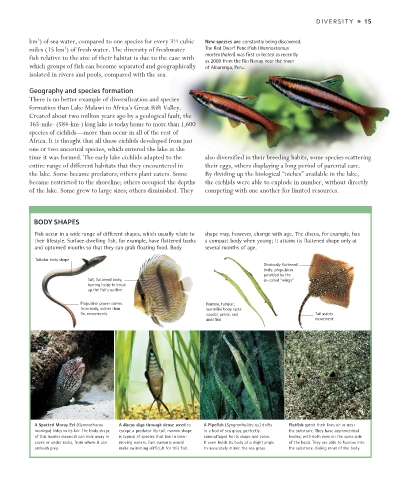
           Fish occur in a wide range of different shapes, which usually relate to   shape may, however, change with age. The discus, for example, has
           their lifestyle. Surface-dwelling fish, for example, have flattened backs   a compact body when young; it attains its flattened shape only at
           and upturned mouths so that they can grab floating food. Body    several months of age.
           Tubular body shape
                                                                          Obviously flattened
                                                                          body; propulsion
                                                                          provided by the
                         Tall, flattened body;                            so-called “wings”
                         barring helps to break
                         up the fish’s outline
                       Propulsive power comes             Narrow, tubular,
                       from body, rather than             wormlike body lacks
                       fin, movements                     caudal, pelvic, and           Tail assists
                                                          anal fins                     movement


           A Spotted Moray Eel (Gymnothorax    A discus slips through dense weed to   A Pipefish (Syngnathoides sp.) drifts    Flatfish spend their lives on or near
           moringa) hides in its lair. The body shape   escape a predator. Its tall, narrow shape    in a bed of sea grass, perfectly   the substrate. They have asymmetrical
           of this hunter means it can hide away in   is typical of species that live in slow-   camouflaged by its shape and color.    bodies, with both eyes on the same side
           caves or under rocks, from where it can   moving waters. Fast currents would   It even holds its body at a slight angle   of the head. They are able to burrow into
           ambush prey.           make swimming difficult for this fish.  to accurately mimic the sea grass.  the substrate, hiding most of the body.


   US_014-015_Diversity.indd   15                                                                    29/08/18   4:08 PM

